
Executive Summary
Switches and crossings (S&C) carry the highest dynamic forces in a railway track and some of its highest costs. Every crossing design balances geometry, steel choice, and cost, but these are usually evaluated in separate simulation tools, material datasheets, and spreadsheets. Neodustria's Unified Industrial Intelligence Platform brings them into one place, where engineers can explore alternatives, document why each choice was made, and reassess decisions when requirements change.
- ~25%: share of track maintenance and renewal budget spent on S&C (Swiss Federal Railways data)
- 10-20%: lifecycle cost reduction achieved by improved track system designs in EU-Rail demonstrators
- 3 Domains: physics, materials, and economics in one decision
- Every Alternative: documented, compared, and traceable
- Selective Revalidation: only affected checks are rechecked
- Review-Ready Evidence: decisions and rationale organized for regulatory review
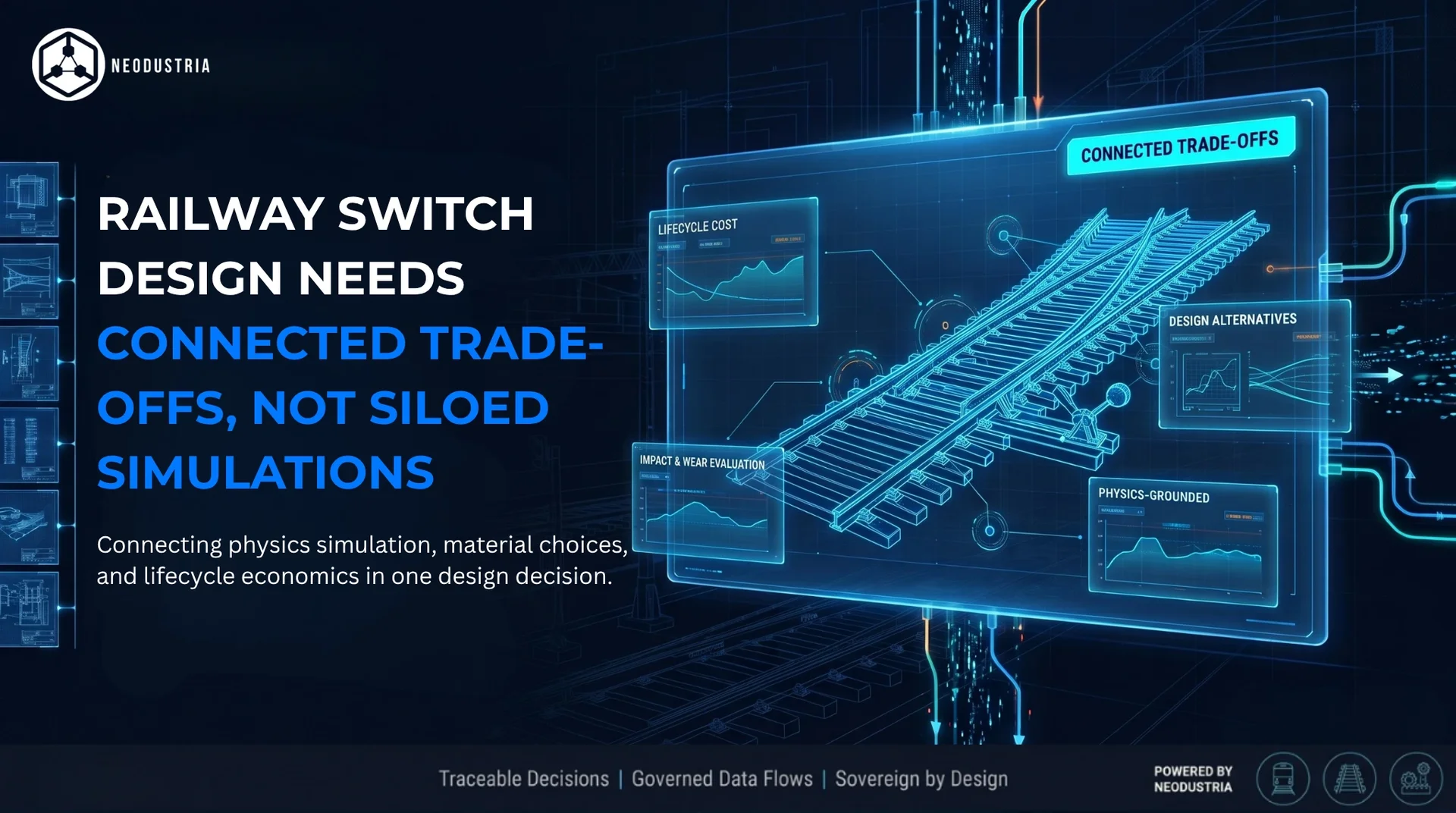
Crossing design is not a single simulation problem. It is a connected decision across physics, materials, and economics.
The Challenge: Fragmented Early-Stage Data
Switches and crossings are among the most demanding components on any European railway. A study (EPFL), based on Swiss Federal Railways data, found that approximately 25 percent of the budget for maintenance and renewal of railway tracks is used for switches and crossings, and that while plain track spending is optimized with tools such as decision support systems, support for S&C remains rather rudimentary.
Across Europe, the pressure is growing. Europe's Rail Joint Undertaking, the EU's rail research body, reports that existing track systems struggle to keep up with increasing traffic, demand for reliability and lifecycle cost, and the need to reduce noise and vibration, and that maintenance costs for track components remain around 50-60% of a railway's total maintenance costs. Better design is one of the main levers: for some track systems, EU-Rail demonstrators achieved a 10-20% reduction in lifecycle cost.
The crossing is the hardest part to design. To let a wheel travel in either direction, the running surface must break. The wheel transfers from the wing rail to the crossing nose, creating a dip, a slope, and the highest impact forces in the system. Research from Chalmers University of Technology found that impact loads can be reduced by lowering the effective dip angle at the crossing, which is set by the wheel's vertical path as it moves between the wing rail and the crossing nose.
- A narrower, sharper nose shortens the gap the wheel must cross and reduces impact but leaves the nose structurally weaker
- A blunter nose is stronger but lengthens the gap and increases impact forces
- Harder steel resists damage at the crossing but increases wear and damage on the wheels that run over it
Every trade-off must also pass regulatory review. Railways are among the most strictly regulated industries, because a single failure can put hundreds of lives at risk. Under the EU's common safety method for risk evaluation and assessment (Regulation (EU) No 402/2013), a significant change requires an independent assessment body in addition to the railway company's own risk assessment, according to the European Union Agency for Railways. Crossing designs change rarely, often years apart, so the evidence behind today's decision is hard to find when the next change needs approval. Even a small change can trigger a large validation campaign that is expensive to prepare and to review. The same pattern holds in other safety-critical industries such as aircraft design, where getting a new or modified component past regulators takes significant time and cost.
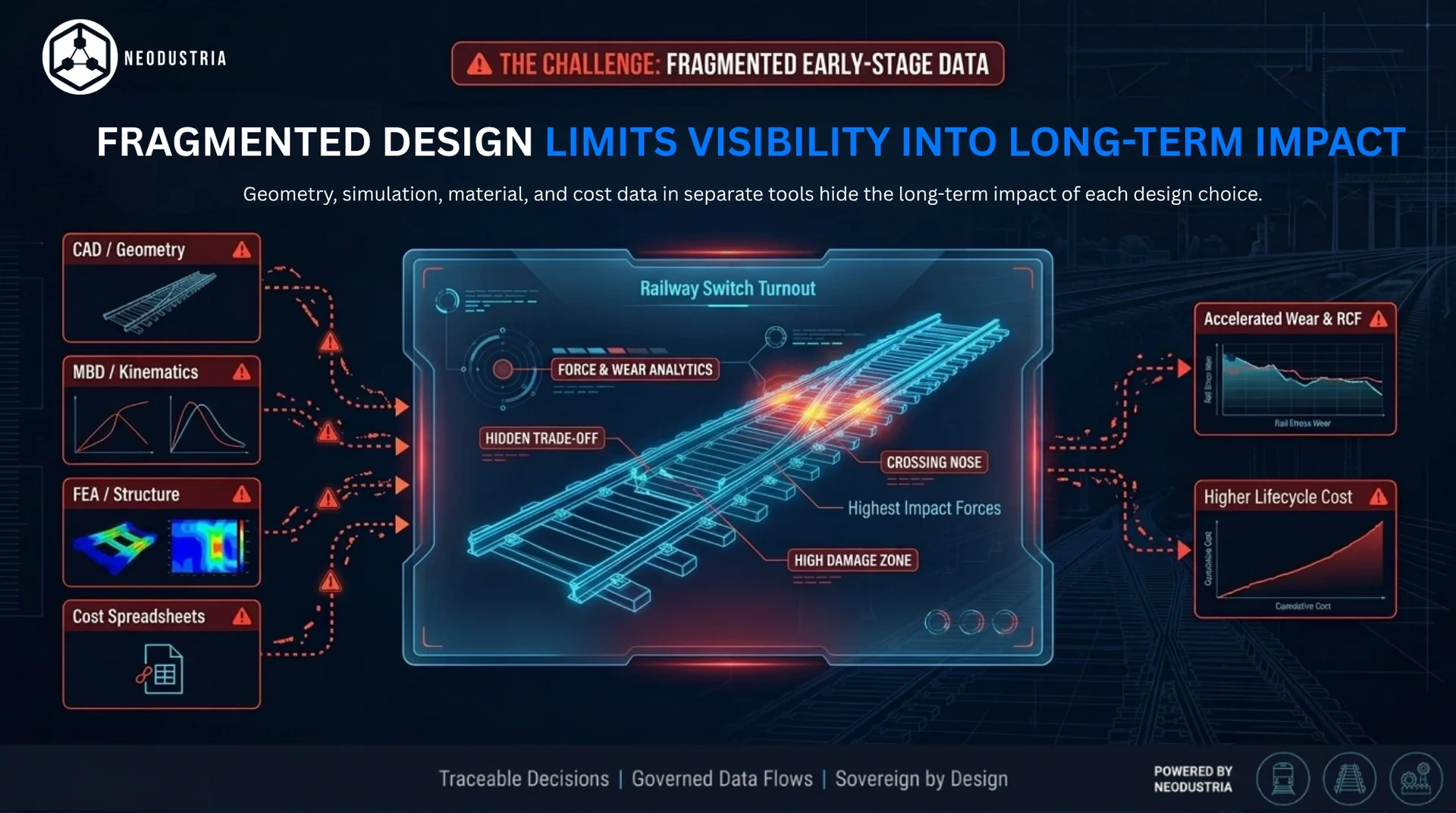
Crossing nose geometry, structural strength, and steel choice pull in different directions.
Design Pain vs Design Demands
| Design Pain | Design Demands |
|---|---|
| Geometry, material, and cost evaluated in separate tools | One environment linking simulation, materials, and economics |
| Design rationale scattered across reports and emails | Every decision documented with its assumptions and evidence |
| A change in axle load or steel price means rechecking everything | Only the affected parts of a decision are rechecked |
| Alternatives compared on one criterion, such as impact load | Alternatives compared on performance, durability, and lifecycle cost |
| Effects on wheels are hard to see at the design stage | Wheel-rail system effects visible before a design is released |
| Every design change needs validation and regulatory review, built from evidence scattered across years of files | Decisions and evidence organized for review, with each change scoped to the analyses it actually affects |
Neodustria's Solution: Precision Industrial Intelligence for Railway Cells
Neodustria, a Swiss industrial intelligence company, approaches crossing design as one connected decision rather than a series of separate analyses. Its Unified Industrial Intelligence Platform links engineering, materials, manufacturing, and economics on one digital thread, treating each design decision, its alternatives, simulation runs, material options, and costs as connected entities in a shared model. Existing simulation tools remain essential, but they were not designed to keep a decision linked to its assumptions across all three domains. Neodustria adds that connection, combining physics-aware engineering surrogates, intelligent digital twins, classical solvers, and external simulations, and matching each method to the accuracy, speed, and cost a problem requires.
- Connect: crossing geometry, including nose profile and transition zone length, is imported from CAD into the 3D Design Cockpit, alongside simulation results, material data, and cost inputs. Existing CAD and simulation tools stay in place.
- Explore: engineers create design alternatives, such as nose profile, steel grade, and support stiffness, as branches of the same decision, without losing the original.
- Evaluate: the Simulation Hub orchestrates multi-body vehicle-track simulations for each alternative, while the ML Workbench trains physics-aware surrogates that estimate impact, strength, and wear with quantified uncertainty. Market Intelligence adds current material and supplier prices to each alternative's lifecycle cost.
- Decide: the team compares alternatives side by side and records the chosen design with the evidence and reasoning behind it.
- Reassess: when axle loads, specifications, or steel prices change, Neodustria flags only the decisions affected, so the team rechecks what matters instead of starting over.
- Prepare for review: the evidence, assumptions, and reasoning behind each decision are kept together in one record, ready to present to the assessment body. When a small change is proposed, Neodustria shows which analyses it affects, so the validation work can focus on what changed instead of rebuilding the full case.
- One decision environment: physics, materials, and economics in one place, instead of separate files and tools
- Better-informed trade-offs: every alternative weighed on impact, strength, durability, wheel wear, and cost together
- Faster design cycles: surrogates and orchestrated simulations reduce the time spent setting up and running each alternative
- Decisions that stay valid: selective revalidation keeps designs current as requirements and prices change
- Review-ready evidence: every decision and its supporting evidence are organized for regulatory review, even years after the original design
- Knowledge that stays with the team: design rationale is preserved, so earlier choices can be reassessed without losing their reasoning
- Built for European industry: EU-hosted, with explainable and auditable outputs, serving engineering teams across automotive, aerospace, aviation, naval, construction, and railway
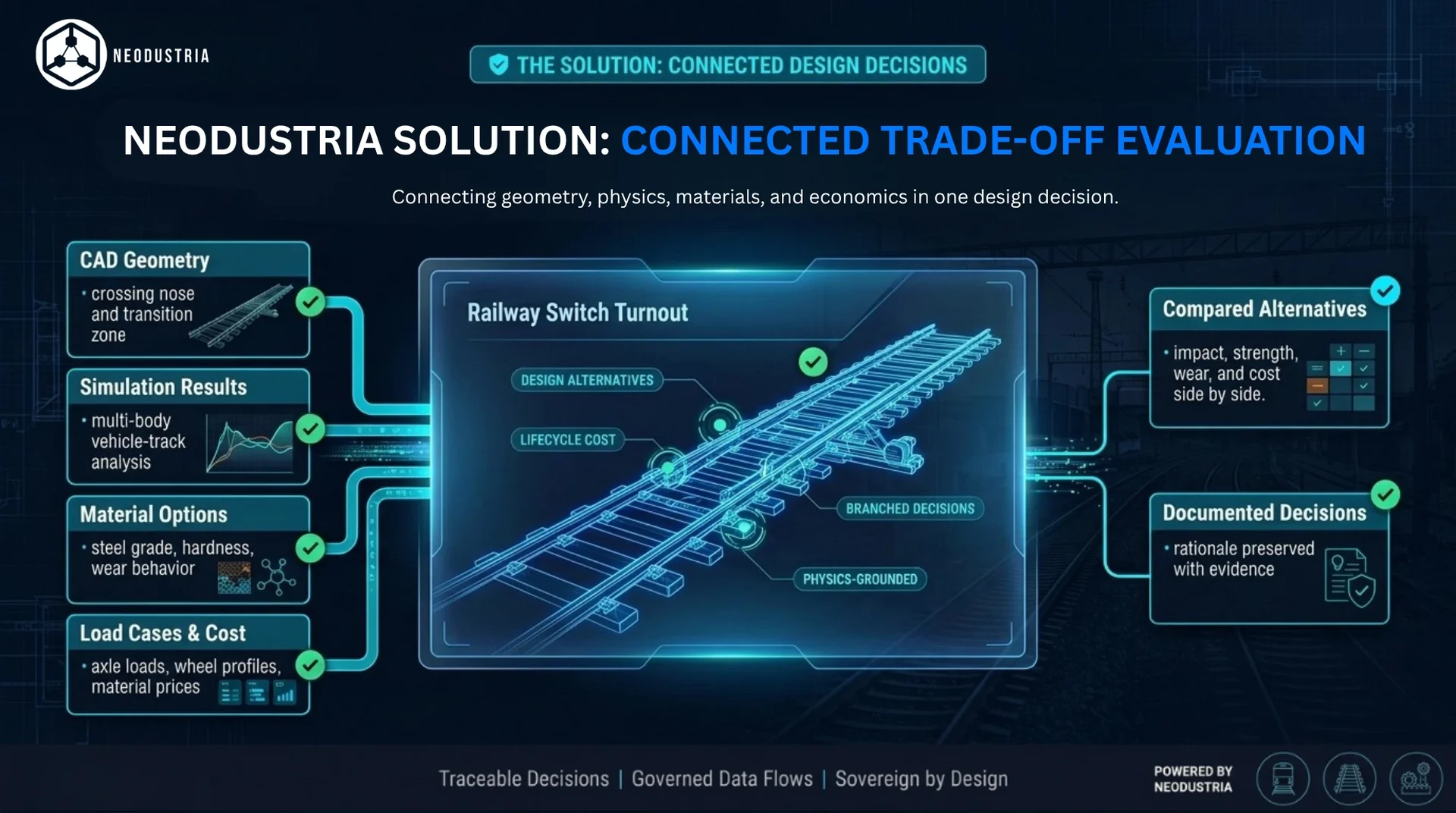
Simulation, material, and cost evidence connected to one crossing design decision.
Scientific Foundation of Neodustria's Design Intelligence
Each crossing design is represented as a linked engineering entity:
- Geometry: crossing angle, nose profile, wing rail height profile, and transition zone length
- Load cases: axle loads, speeds, traffic mix, and a representative set of wheel profiles, including worn profiles
- Material: steel grade and hardness options for the crossing nose and wing rails
- Support: rail pad and bearer stiffness
- Economics: manufacturing cost, material price, expected maintenance, and replacement interval
- Vehicle-track dynamics simulation, connected from existing solvers
- Wheel-crossing contact surrogate
- Impact load and damage estimation
- Materials Intelligence for grade and wear behavior
- Lifecycle cost model (Economic Intelligence)
- Decision model linking alternatives, assumptions, and evidence
- Wheel-rail contact mechanics, including non-Hertzian contact at the crossing
- Vertical vehicle-track interaction during the wing rail to crossing nose transition
- Structural load limits of the crossing panel
- Wear and plastic deformation by steel grade
- Fatigue behavior of crossing materials
- Cost and supply constraints for each material option
Earlier Chalmers research shows why a representative set of wheels matters: it optimized crossing geometry for a representative set of wheel profiles to make the design robust, minimizing the maximum wheel-rail contact pressure and the accumulated damage in the transition zone between the wing rail and the crossing nose. Neodustria applies the same principle. Every comparison stays physically consistent, in line with Neodustria's Research Vision: intelligence grounded in engineering laws, not just patterns.
Projected Design Impact
| Metric | Traditional Workflow | With Neodustria | Projected Change | Basis |
|---|---|---|---|---|
| Crossing lifecycle cost | Design optimized for one criterion | Optimized across impact, durability, wheel wear, and cost | 10-20% lower | In line with EU-Rail track system demonstrators |
| Simulation cycle time | Each alternative set up and run separately | Surrogates and orchestrated simulation runs | Up to 50% faster | Neodustria Engineering Platform |
| Alternatives compared per design cycle | One or two, on a single criterion | Several, on all criteria together | More alternatives | Qualitative |
| Effort after a requirement change | Full recheck | Only affected checks | Lower | Qualitative |
| Design rationale | Spread across reports | Preserved with each decision | Fully traceable | Qualitative |
| Validation effort for a small design change | Large validation campaign rebuilt from scattered files | Analysis scoped to what the change affects, with evidence ready | Lower | Qualitative |
Illustrative projection for a crossing design program. Actual results depend on the program, the design, and regulatory requirements.
Without vs With Neodustria
| Aspect | Without Neodustria | With Neodustria | Impact |
|---|---|---|---|
| Comparing alternatives | One criterion at a time | Impact, strength, wear, and cost together | Better-balanced designs |
| Material and price changes | Updated manually, often late | Market data linked to lifecycle cost | Cost decisions based on current prices |
| When a requirement changes | Full manual recheck | Only affected checks revalidated | Faster response to change |
| Design rationale | Spread across reports and emails | Preserved with each decision | Decisions can be revisited and defended |
| Wheel-rail system effects | Often evaluated separately | Visible in the same comparison | Fewer surprises after release |
| Regulatory review | Evidence reassembled for each submission, often years after the decision | Decisions and evidence organized and ready to present | Smoother, less costly reviews |
| Where evidence lives | Separate simulation files, datasheets, and spreadsheets | One connected decision model | Less time searching, fewer inconsistencies |
Crossing Nose Design Options
| Design Option | What Improves | What It Costs |
|---|---|---|
| Narrower, sharper nose | Smaller gap for the wheel, lower impact load | Lower structural strength at the nose |
| Blunter nose | Higher structural strength | Longer gap for the wheel, higher impact load |
| Harder steel grade | Greater durability at the crossing | More wear and damage on wheels, higher material cost |
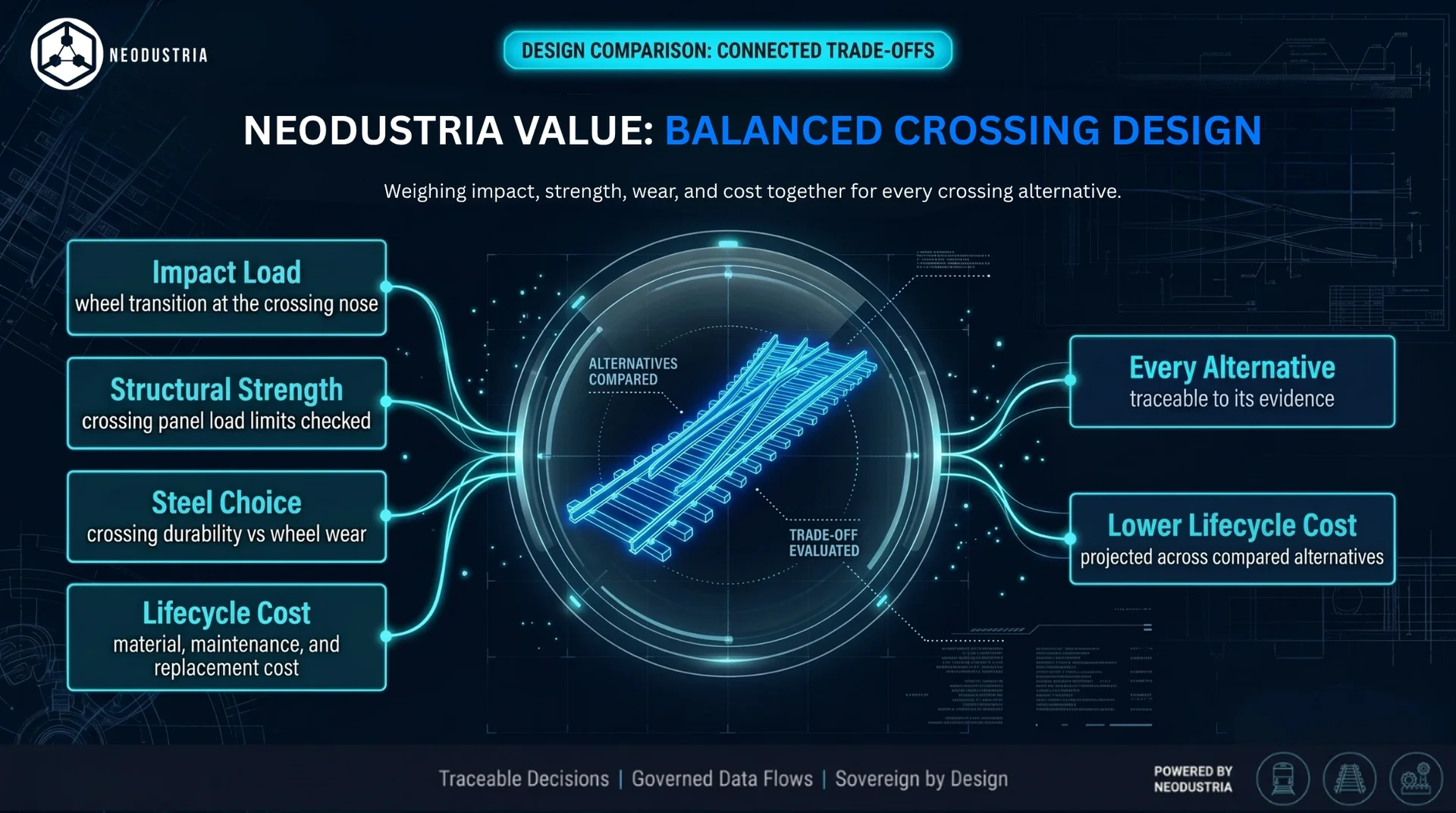
Each crossing alternative compared across impact, strength, durability, and wheel wear.
Engineering Methodology
- Crossing geometries imported from CAD
- Multi-body vehicle-track simulations covering a range of speeds and axle loads
- Representative wheel profile sets, including worn profiles
- Material property data by steel grade and hardness
- Manufacturing, material, and maintenance cost inputs
- Physics-constrained training of contact surrogates against simulation data
- Uncertainty quantification on every comparison
- Integration with existing CAD, PLM, and simulation tools
- Selective revalidation when inputs change
A representative evaluation shows how connected design intelligence supports a crossing decision:
- A sharper nose reduces impact load but lowers structural margin, so it is checked against the crossing panel's structural load limits
- A harder steel grade improves crossing durability, so its effect on wheel wear and material cost is weighed in the same comparison
- When axle load requirements or steel prices change, the affected alternatives are flagged for reassessment, with the original rationale preserved
- Before release, the chosen design's evidence, assumptions, and rationale are compiled into one record for regulatory review, and any later change shows which parts of that record it affects
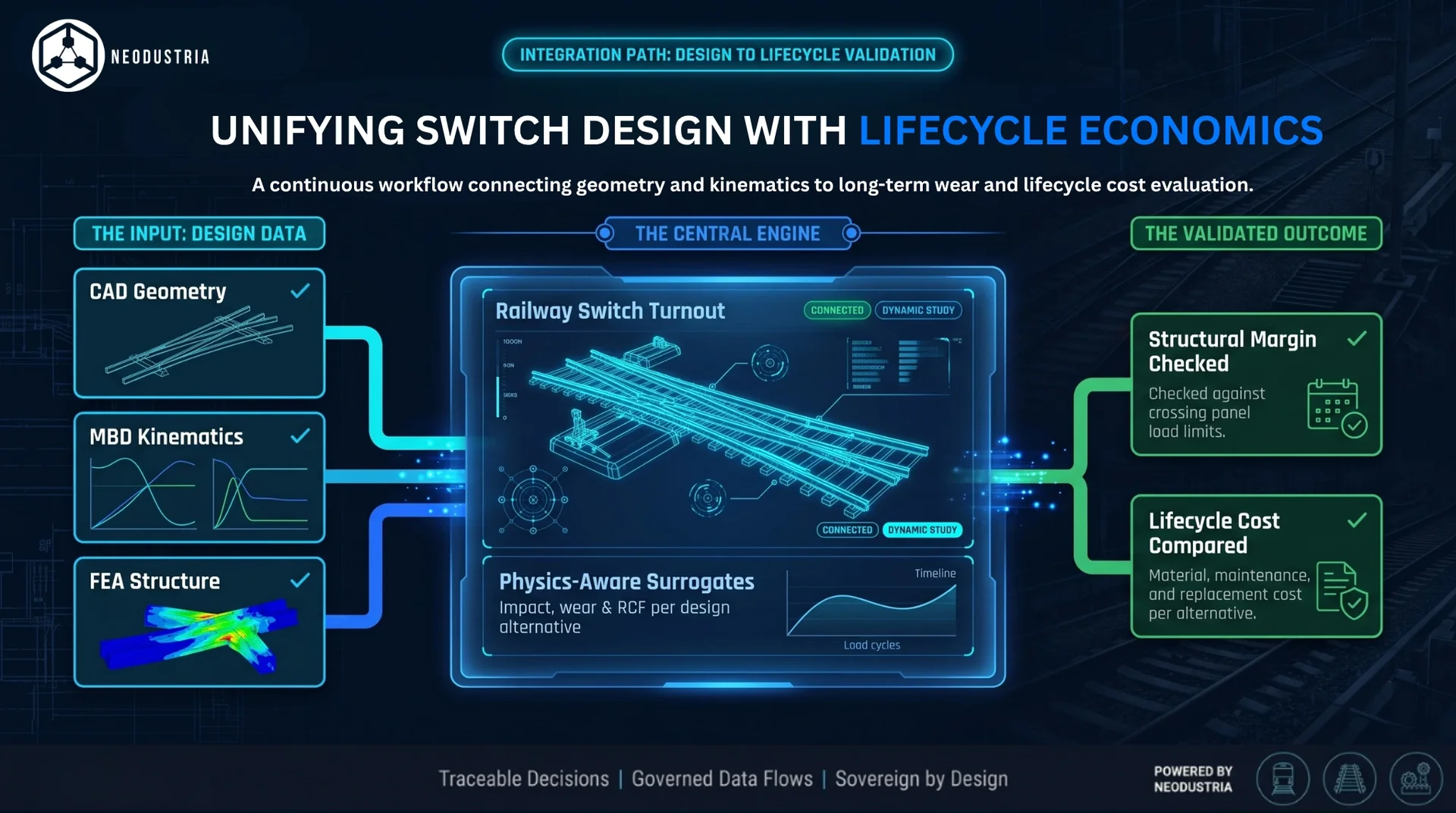
From design data to lifecycle cost, in one connected evaluation.
Business Impact
For component designers, the value is not one more simulation. It is a single place where every crossing decision, and the reason behind it, can be explored, compared, and revisited.
These gains come from connecting engineering evidence that already exists, not from adding more simulations or more staff. In a regulated industry, that same connected evidence also makes every design decision easier to present, defend, and revisit with the authorities.
- Research collaborations with European universities on crossing geometry and wheel-rail impact
- Validation of contact surrogates against published crossing simulation results
- Joint work on materials and lifecycle cost models for S&C components
- Co-development with European component manufacturers on design decision workflows
- Works alongside existing CAD, PLM, and simulation tools through open connectors and APIs
- Connects simulation, materials, and cost data in one environment
- EU-hosted deployment with region-pinned engineering data
- Paid pilot entry through the Neodustria Pilot Program
Conclusion
Railway crossing design is a balance between physics, materials, and cost. Neodustria keeps that balance visible and documented throughout the design process.
- From separate simulation, material, and cost files → one connected design decision
- From comparing one criterion at a time → comparing performance, durability, and lifecycle cost together
- From rechecking everything after every change → revalidating only what is affected
- From design rationale lost in reports → every choice preserved with its evidence
- From rebuilding evidence for every regulatory review → decisions and evidence ready to present
In railway, as in every safety-critical industry, a design is only as strong as the evidence that can be presented to the regulator.
Neodustria brings Physics, Materials, and Economic Intelligence to railway component design, so every crossing decision is made with the full trade-off in view.