
Executive Summary
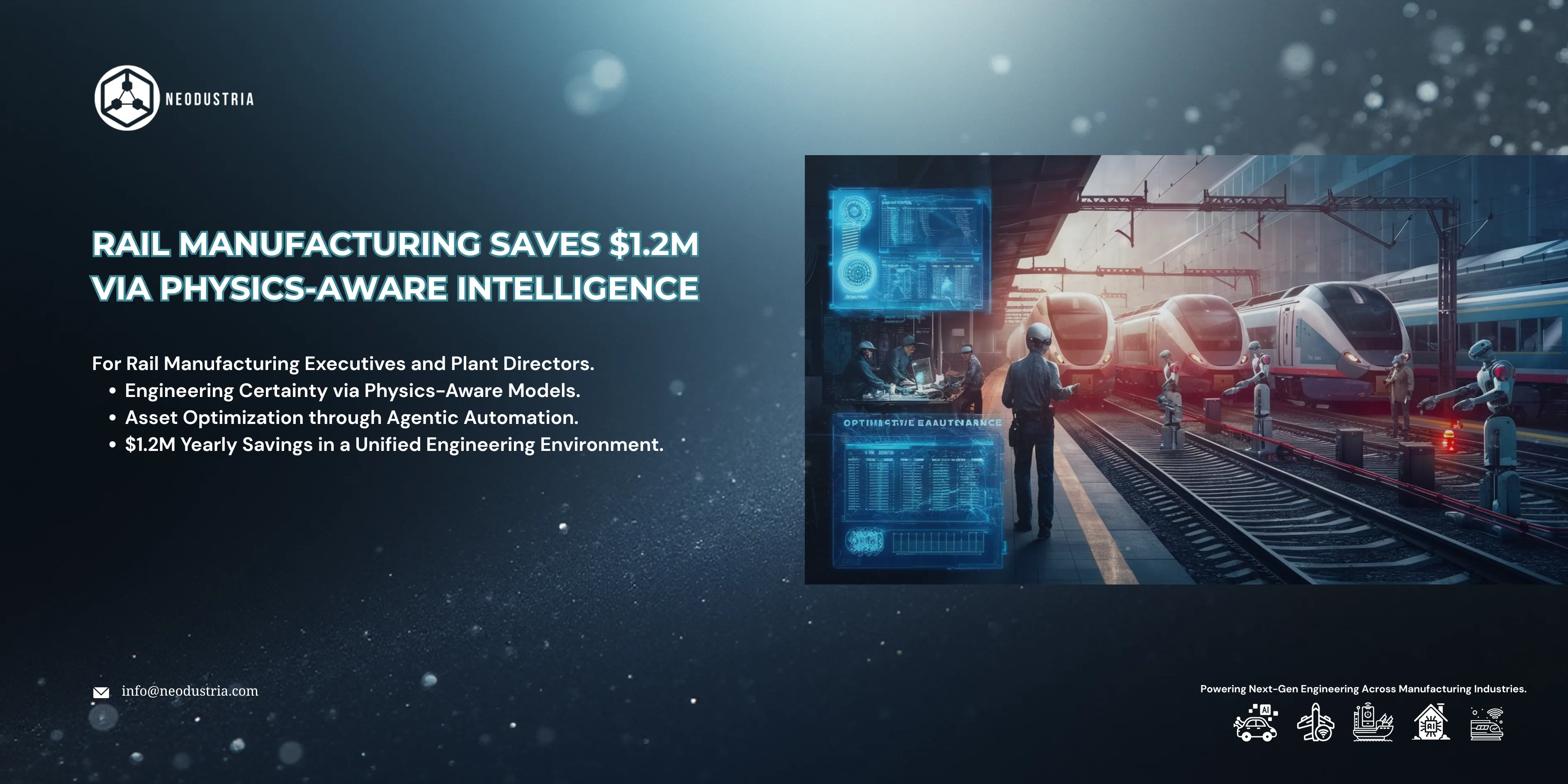
Rail manufacturing does not lose money due to poor engineering capability. It loses money due to process friction — the accumulated cost of manual coordination, disconnected systems, and invisible cross-cell delays that no single team can see or resolve.
Across large rail manufacturing operations:
- ⬢ Manual coordination between production cells takes 72+ hours per cycle
- ⬢ MES, SCADA, and PLC systems operate as isolated silos without shared intelligence
- ⬢ Process friction events occur 15+ times per week, each compounding into downstream delays
A global Tier-1 rail manufacturer deployed Neodustria's physics-aware industrial intelligence to unify all operational systems and eliminate industrial inertia across its manufacturing floor.
Neodustria replaces fragmented industrial operations with a single physics-aware intelligence layer: systems become unified, coordination becomes autonomous, and process friction becomes detectable and eliminable before it compounds into cost.
Business Context & Strategic Impact
Modern rail manufacturing programs operate under conditions that amplify operational cost:
- ◆ Multi-cell production floors with no shared data layer
- ◆ Legacy MES, SCADA, and PLC systems operating independently
- ◆ Manual handoffs between engineering, production, and quality teams
- ◆ Downtime caused by undetected cross-cell delays and system misalignment
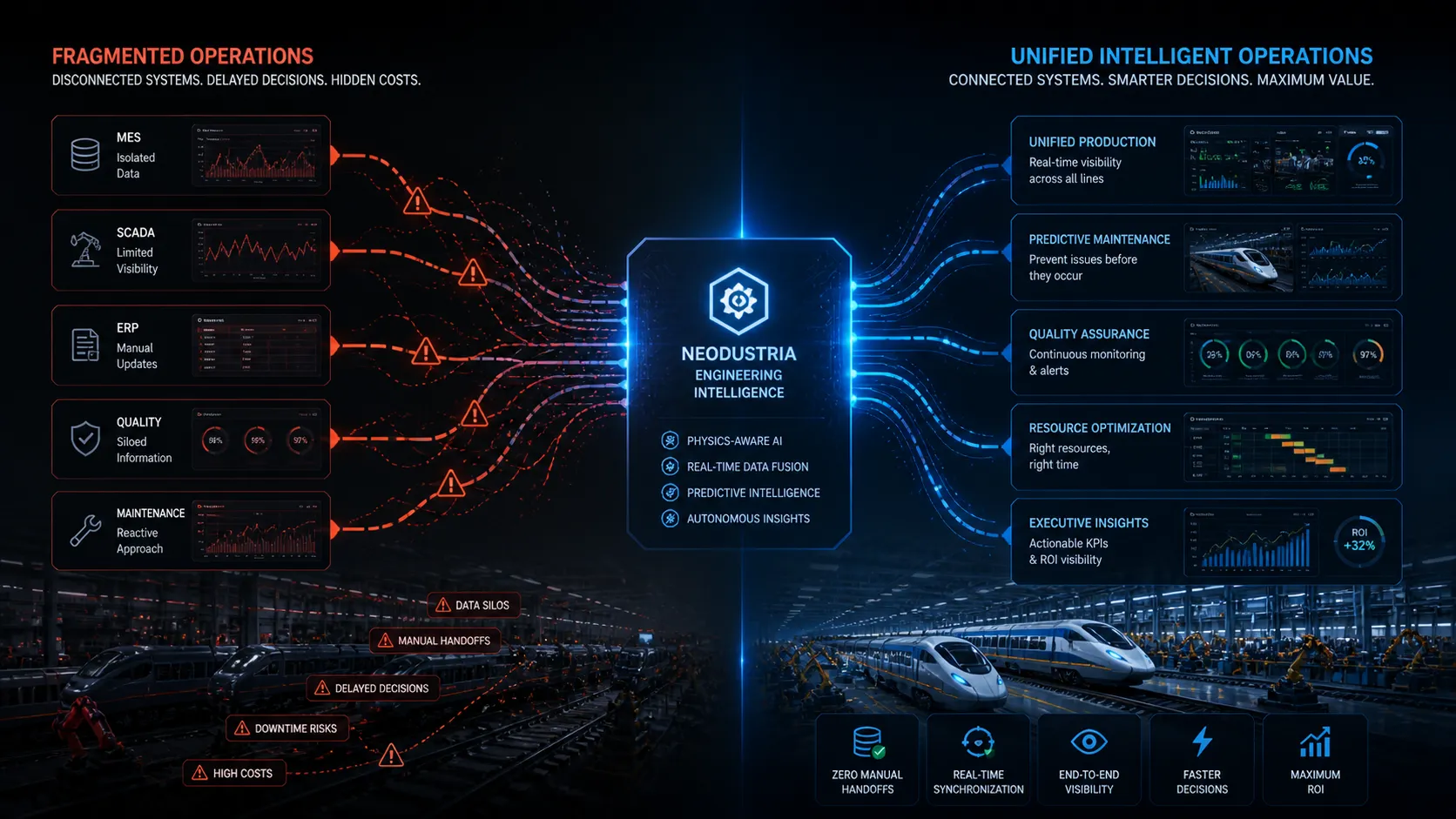
System unification: MES, SCADA, and PLC integrated into a single physics-aware intelligence layer.
Compounding Operational Cost
▢ No unified visibility across MES, SCADA, and PLC systems
▢ Manual coordination cycles consuming 72+ hours per production event
▢ Process friction creating 15+ disruption events per week
▢ Cross-cell delays occurring 20+ times per month with no detection
▢ Unplanned downtime averaging 12 hours per week across production cells

This was not an engineering failure. It was a systems integration failure — the absence of a shared operational intelligence layer.
Operational Pain
- Manual coordination loops consuming days, not hours
- MES, SCADA, and PLC systems operating without shared context
- Process friction invisible until it compounds into downtime
- Cross-cell delays escalating manually, weeks after formation
- $3.8M annual operational cost with no path to reduction
Operations Demands
- Full MES / SCADA / PLC unification without disruption
- Autonomous coordination across all production cells
- Real-time friction detection with engineering evidence
- Zero manual handoffs between systems and teams
- Measurable, auditable cost reduction at scale
Neodustria's Solution: Physics-Aware Intelligence for Rail Manufacturing
The Neodustria Nexus establishes a single physics-aware intelligence layer, unifying MES, SCADA, PLC, and production telemetry across all manufacturing cells into a Sovereign Industrial Cloud.
- Cells focus on specific coordination and intelligence functions across production
- Neurons process high-fidelity signals from MES, SCADA, PLC, and floor telemetry
- Cell leaders and intelligence architects define operational constraints and coordination logic

- MES systems and production execution data
- SCADA systems and real-time operational telemetry
- PLC signals and floor-level automation data
- Physics-Aware Validation representations of manufacturing reality
Intelligence Capabilities Deployed
Full MES / SCADA / PLC Unification
Neodustria neurons ingest real-time signals across all production systems, creating a unified operational picture across every manufacturing cell.
MES, SCADA, and PLC systems unified for the first time into a single physics-aware intelligence layer — zero manual handoffs.
Autonomous Coordination Across Production Cells
Instead of relying on manual loops, Neodustria autonomously coordinates across all production cells, enforcing operational constraints in real time.
Manual coordination reduced from 72 hours to 6 hours — a 92% reduction.
Real-Time Process Friction Detection
Physics-aware models identify divergence from approved operational envelopes before friction compounds into downtime or cost overrun.
Weekly process friction events reduced from 15 to 2 — an 87% reduction.
Downtime Elimination Through Predictive Intelligence
Neodustria detects cross-cell delays and system misalignments before they create unplanned production stops.
Weekly production downtime reduced from 12 hours to 1 hour — a 91% reduction.
From Fragmented Operations to Unified Intelligence
With Neodustria, process friction is detected at formation and linked to operational constraints — transforming manufacturing from reactive coordination into continuous autonomous control.
- ◆ Detect friction while it is forming across production cells
- ◆ Trace delay to root operational constraints
- ◆ Coordinate autonomously without manual intervention
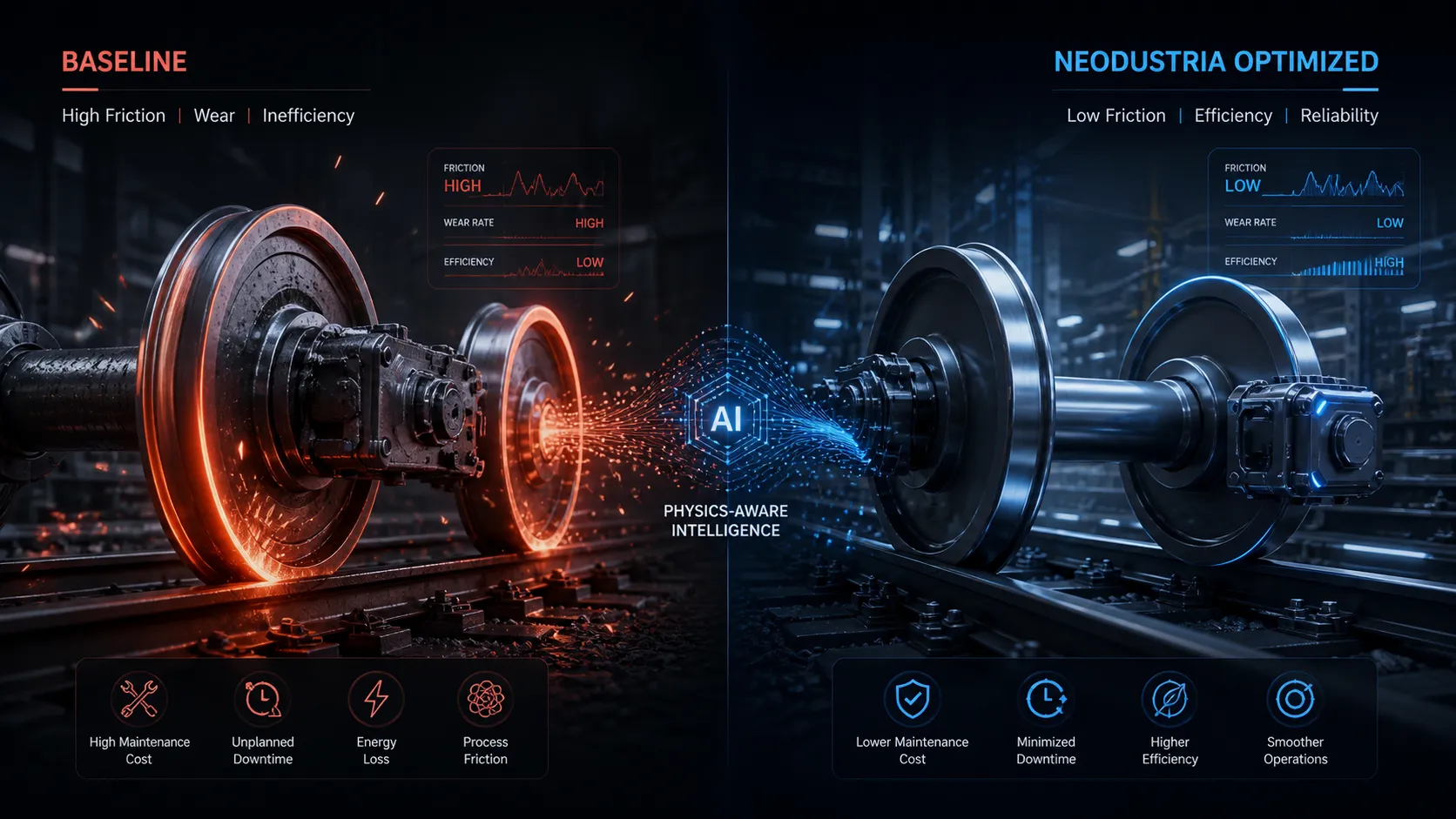
Operational shift: from fragmented legacy state to Neodustria-optimized, friction-free manufacturing.
Quantitative Results
| Metric | Legacy State | Neodustria State | Impact |
|---|---|---|---|
| Manual coordination time | 72 hours | 6 hours | −92% |
| Weekly process friction events | 15 / week | 2 / week | −87% |
| Annual operational cost | $3.8M | $2.6M | −$1.2M saved |
| Weekly production downtime | 12 hours | 1 hour | −91% |
| Monthly cross-cell delays | 20 / month | 3 / month | −85% |
Visualization & Operational Intelligence
- ▣ Process Friction Heatmaps: highlight delay risk across production cells and shifts
- ▣ Coordination Certainty Indicators: show alignment between systems and operational constraints
- ▣ Cost Trajectory Views: track how friction reduction translates into measurable annual savings
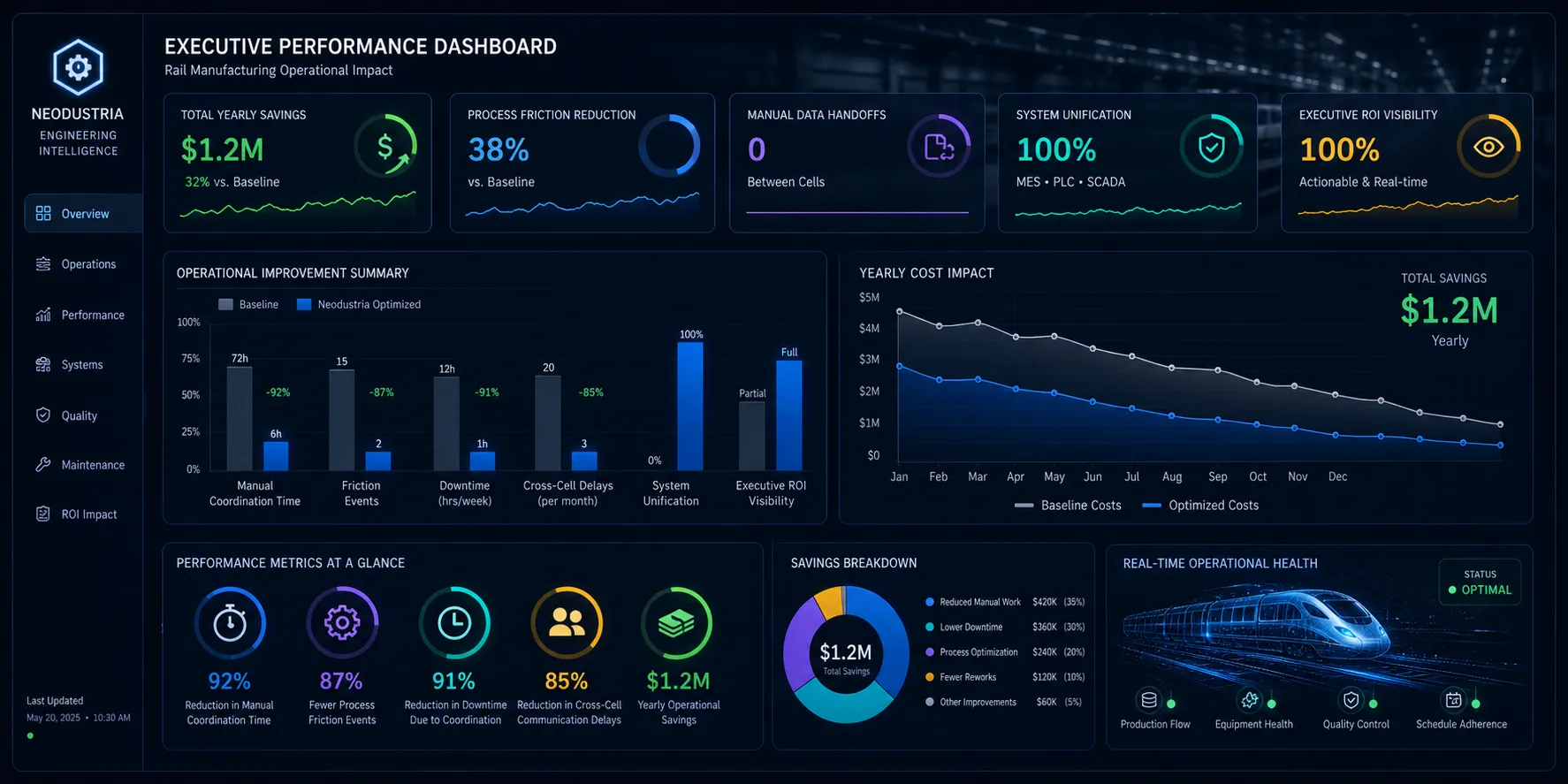
These views support cell leaders and intelligence architects in maintaining zero-friction operational control.
Validation Scope & Methodology
- ▣ Global Tier-1 rail manufacturer
- ▣ Multi-cell production floor across primary facilities
- ▣ Full MES, SCADA, and PLC integration
- ▣ Safety-critical rail component manufacturing programs
Success was measured by:
- ➕ Reduction in manual coordination time and frequency
- ➕ Measurable annual cost savings versus baseline
- ➕ Elimination of unplanned production downtime
System-agnostic connectors ingest MES/SCADA/PLC signals without disrupting live rail manufacturing programs.
Business Impact
Voice of the Plant
"Neodustria removed all process friction across our operations. Manual coordination that previously took 72 hours now completes in 6, generating $1.2M in annual savings and measurable engineering certainty."
— Plant Director, Global Rail Manufacturer
- ▣ Zero manual handoffs across MES, SCADA, and PLC systems
- ▣ $1.2M annual savings from friction elimination and downtime reduction
- ▣ Predictable production execution with governed autonomous coordination
- ☰ Full operational visibility across all production cells
- ☰ Engineering certainty replacing manual coordination loops
- ☰ Auditable evidence trails for every operational decision
Intelligence Loop