
Executive Summary
Rail manufacturing operations are increasingly constrained by process friction, manual coordination, and disconnected execution systems. These constraints introduce engineering uncertainty, production delays, and rising operational costs across industrial cells.
Business Context & Strategic Impact
The Challenge: Operational Drag in Rail Manufacturing
- Manual coordination creates downtime and yield loss
- Fragmented MES, SCADA, and ERP systems slow workflows
- Misaligned production schedules increase scrap and engineering uncertainty
- Lack of unified oversight reduces Engineering Certainty
Industrial Inertia Manifests As
- Repeated manual reconciliations across engineering, quality, and production cells
- Process friction during cross-cell handoffs between upstream and downstream workflows
- Delayed prototype testing and validation
- Loss of actionable metrics for strategic decision-making
Market Demands
- Accelerate production cycles without increasing risk
- Minimize scrap and downtime across multiple platforms
- Unify fragmented industrial operations (MES/SCADA/ERP)
- Quantify Executive ROI on every process improvement
Neodustria’s Solution: Engineering Intelligence for Rail Manufacturing Cells
Neodustria deploys precision, physics-aware industrial intelligence to eliminate industrial inertia while providing engineering certainty across all operations — without disrupting existing systems.
Neural Workflow Integration
- Automated creation of Physics-Based Twins from CAD/STEP and high-fidelity telemetry
- Physics-aware models predict stress, load, fatigue, and workflow bottlenecks
- Prescriptive workflow recommendations for process unification
- Real-time operational visibility for intelligence architects and operators
- Continuous learning from cross-cell neuron feedback
Key Engineering & Operational Benefits
- 95% faster digital twin simulations for each rail cell
- Full removal of manual process friction
- Complete MES/SCADA system unification
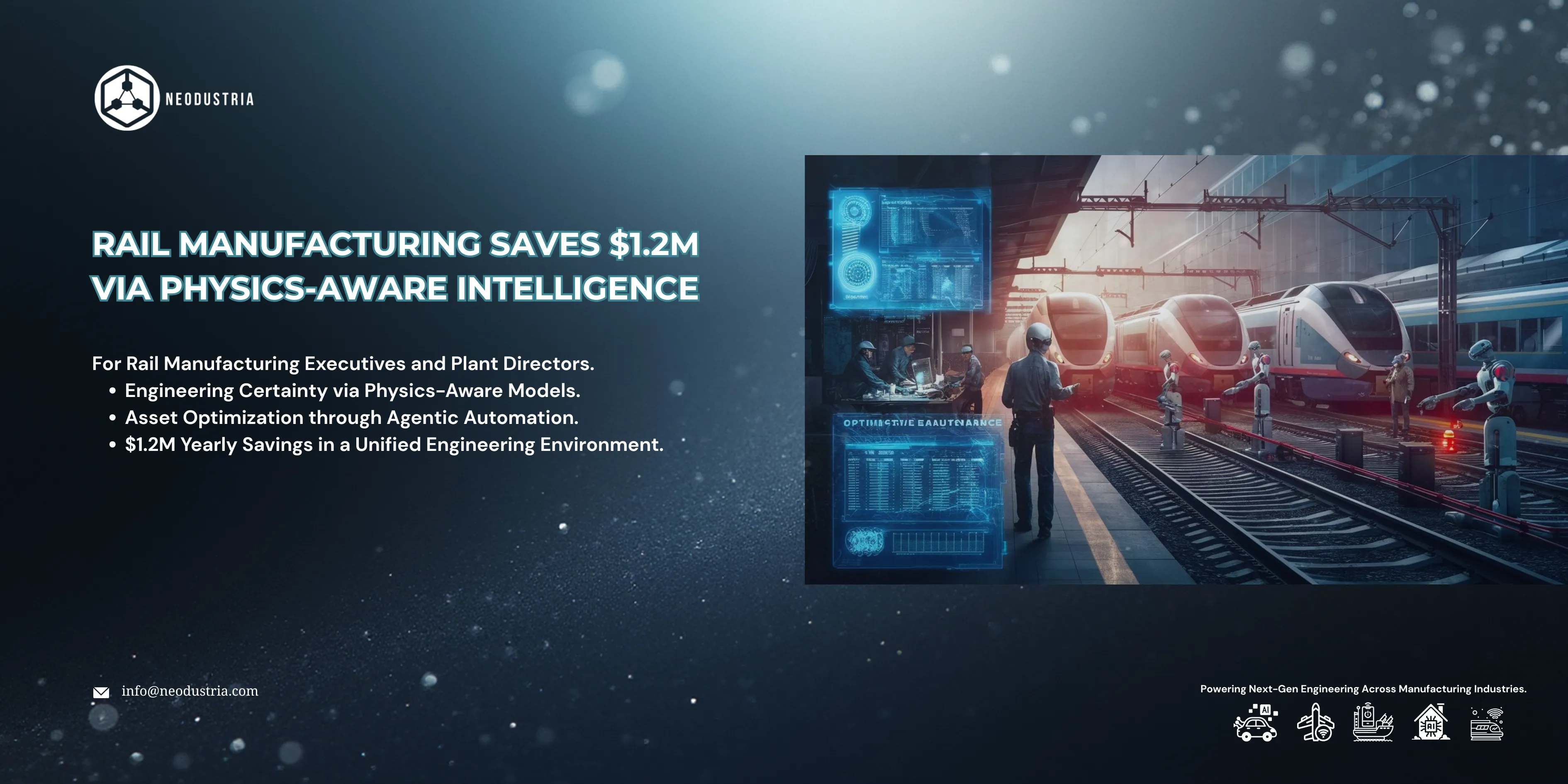
- Rapid iteration enabling $1.2M yearly savings
- Executive ROI quantified and visible in real time
- Reduced asset fatigue and downtime risk
- Predictive maintenance cycles integrated automatically

KPI dashboard: real-time executive ROI visibility, friction hotspots, coordination time collapse, and unified operations across rail production cells.
Unique Features for Rail Manufacturing
- Cross-Cell Coordination Analysis: visualizes process friction hotspots across departments
- Predictive Resource Allocation: optimizes machines and personnel scheduling
- Process Bottleneck Identification: isolates repetitive tasks causing downtime
- Simulation-Based ROI Modeling: calculates exact executive ROI from workflow optimization
This capability set converts fragmented execution into a unified, auditable operating system — enabling rail leaders to steer complexity with predictive certainty instead of reactive coordination.
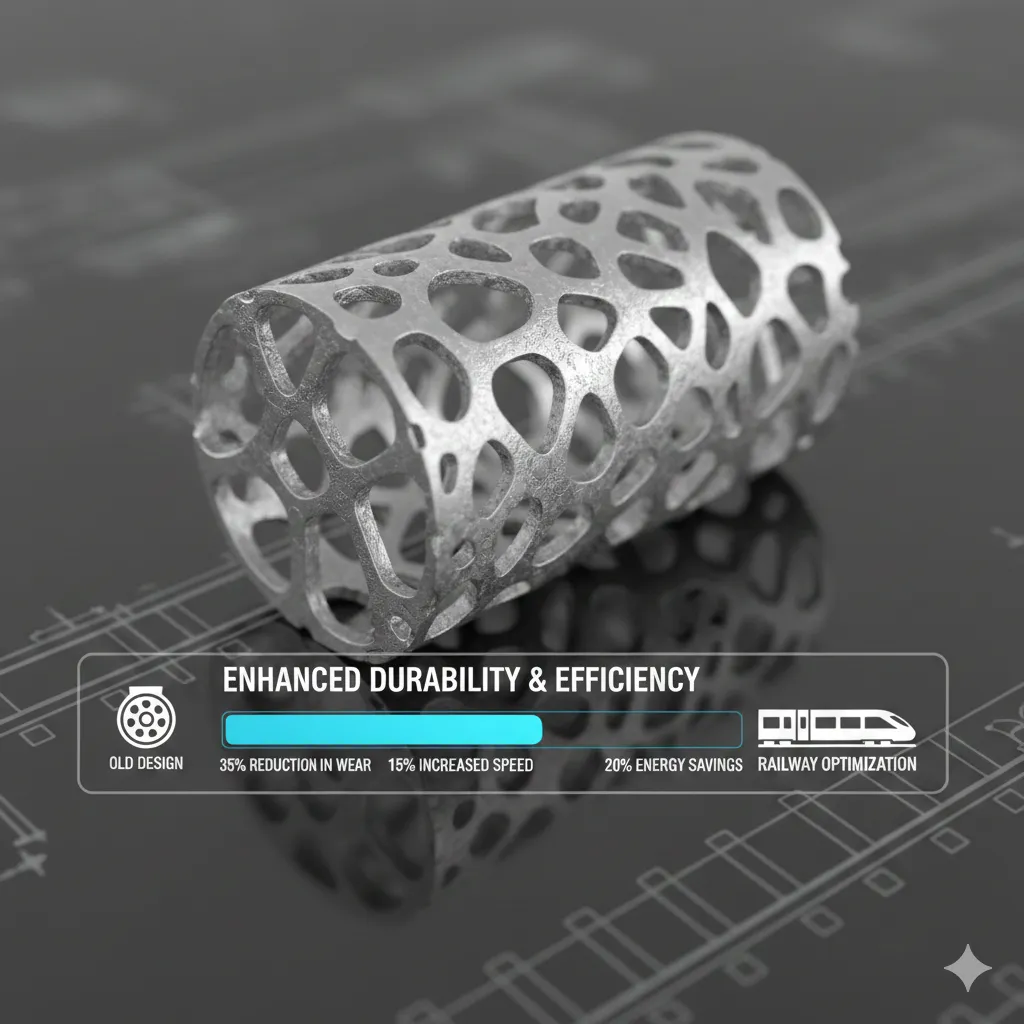
Cross-cell friction heatmap: where manual handoffs accumulate hidden cost exposure and downtime risk.
Quantitative Results
After deployment, the Tier-1 rail manufacturer collapsed coordination time, reduced friction events, and made executive ROI fully actionable.
| Metric | Baseline | Neodustria Optimized | Improvement |
|---|---|---|---|
| Manual Data Coordination Time | 72h/week | 6h/week | 92% |
| Process Friction Events | 15/week | 2/week | 87% |
| Yearly Operational Costs | $3.8M | $2.6M | $1.2M Saved |
| System Integration Completion | 0% | 100% Unification | Full |
| Executive ROI Visibility | Partial | Full & Actionable | 100% |
| Downtime Due to Coordination | 12h/week | 1h/week | 91% |
| Cross-Cell Communication Delays | 20/month | 3/month | 85% |
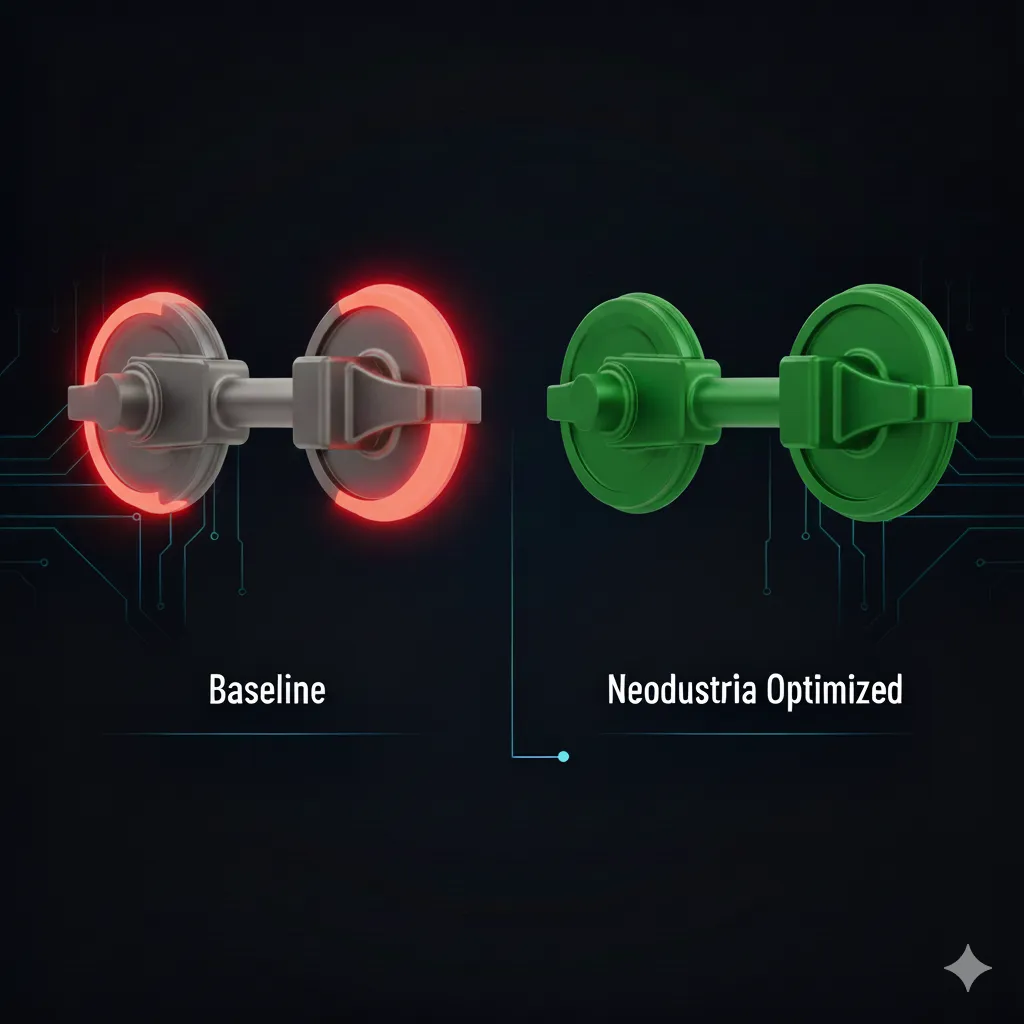
From Manual Coordination to Physics-Aware Execution
Engineering Methodology
Dataset & Simulation Scope
- 1,200+ operational process scenarios across rail manufacturing lines
- 10+ rail vehicle platforms, including freight and high-speed units
- Telemetry and MES logs processed at 1–20M resolution per simulation
- Physics-constrained models for workflow, friction, and load analysis

Methodology: physics-aware twins + operational telemetry unify engineering decisions across rail production cells.
Training & Workflow Strategy
- Multi-task physics-aware intelligence models for friction, load, and stress prediction
- Digital twin augmentation for each rail manufacturing cell
- Integration with MES, PLC, and SCADA for real-world operational fidelity
- Continuous improvement through engineering feedback loops
Business Impact for Rail Manufacturing Cells
“Neodustria removed all process friction across our operations. Manual coordination that previously took 72 hours now completes in 6, generating $1.2M in annual savings and measurable engineering certainty.”
Potential Partnerships & Research Use Cases
- Academic collaborations on physics-aware industrial intelligence
- Access to real-world rail manufacturing telemetry datasets
- Advanced digital twin curriculum for operational training
- Co-publication with leading rail research laboratories
Deployment Model
- Integration with Autodesk, Siemens, Dassault, and PTC CAD/MES APIs
- Sovereign industrial cloud, hybrid, or on-prem deployment per rail cell
- Multi-cell neural architecture across industrial operations

Deployment architecture: physics-aware intelligence deployed per rail production cell across sovereign, hybrid, and on-prem environments.
Conclusion
Neodustria converts industrial inertia into operational certainty:
- From fragmented workflows → unified rail manufacturing operations
- From slow coordination → physics-aware predictive intelligence
- From manual iteration → neuron-driven autonomous execution
- From hidden costs → $1.2M yearly savings and quantified executive ROI