
Executive Summary
For Aerospace Engineers, Program Managers, and Design Leads, late-stage prototyping failures create uncertainty and budget exposure. Using Neodustria’s Precision Industrial Intelligence Validation Engine, an aerospace manufacturer achieved the following outcomes.
With Neodustria’s platform, prototyping confidence becomes predictive, physics-aware, and financially risk-free.
Industry Context & Strategic Impact
The Challenge: Expensive, Slow, and Uncertain Aerospace Prototyping
Aircraft components must withstand extreme multi-axis forces across operational lifecycles: aerodynamic pressure fluctuations, thermal expansion, high-cycle and low-cycle fatigue, and complex load transfer across spars, ribs, joints, and fasteners.
Traditional Validation Methods
- CFD: 30–100 hours per flow condition
- FEM: 12–40 hours per structural region
- Wind tunnel + pressure rig testing: $200k–$500k per prototype
- Material coupon tests: days to weeks
- Manual safety-factor and margin verification: 3–6 weeks
Business Consequences
- Excessive material waste
- High prototyping risk
- Slow iteration cycles
- Limited ability to test design variants
- Delayed certification and compliance
- Reactive—not predictive—design decisions
Neodustria transforms aerospace prototyping into a physics-grounded, geometry-and-materials-validated digital pipeline.
Scientific Foundation
Multi-Layer Aero-Structural Representation
Neodustria converts CAD and engineering datasets into a physics-aware, multi-resolution structural model.
- High-fidelity volumetric mesh reconstruction
- 3D stress-gradient fields
- Aero-thermal load ontology (pressure, lift, drag, heat flux, torsion)
- Material behavior library (titanium, composites, carbon fiber, alloys)
- Fatigue and damage accumulation mapping
- Vibrational modal signatures (Mode 1–12)
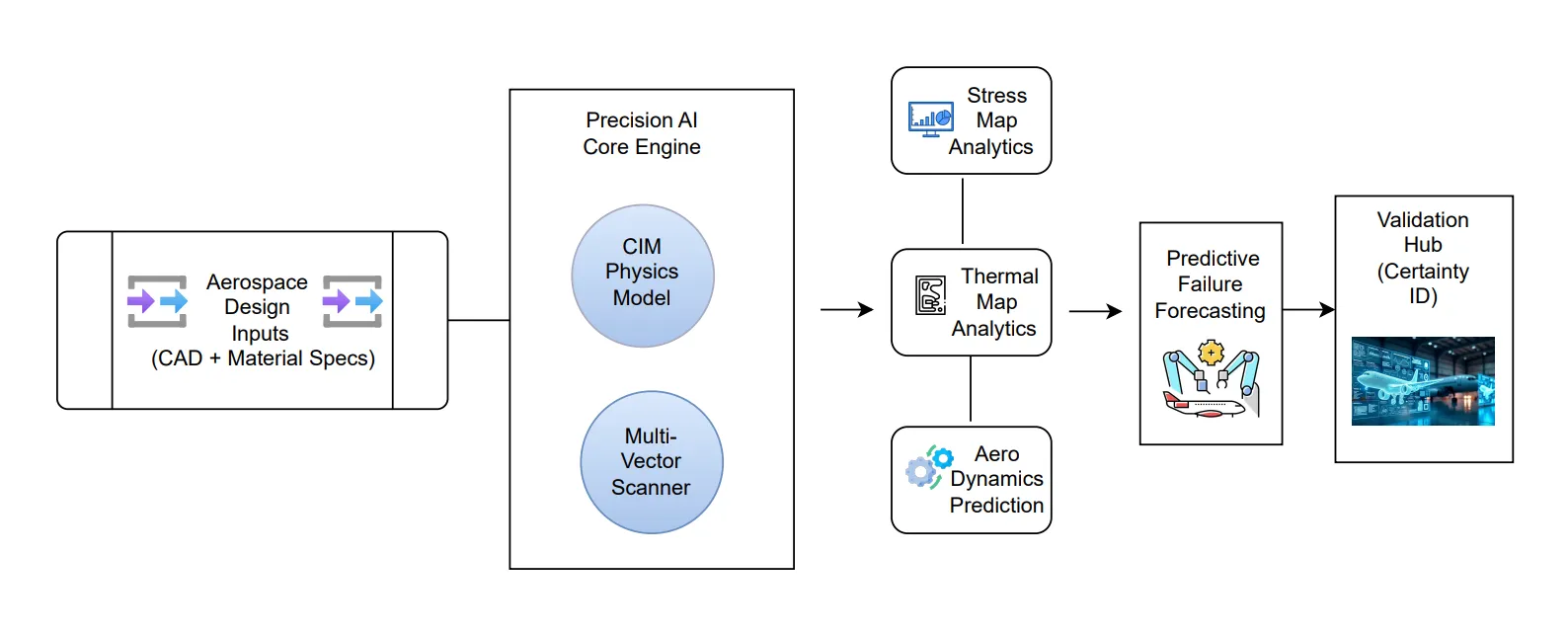
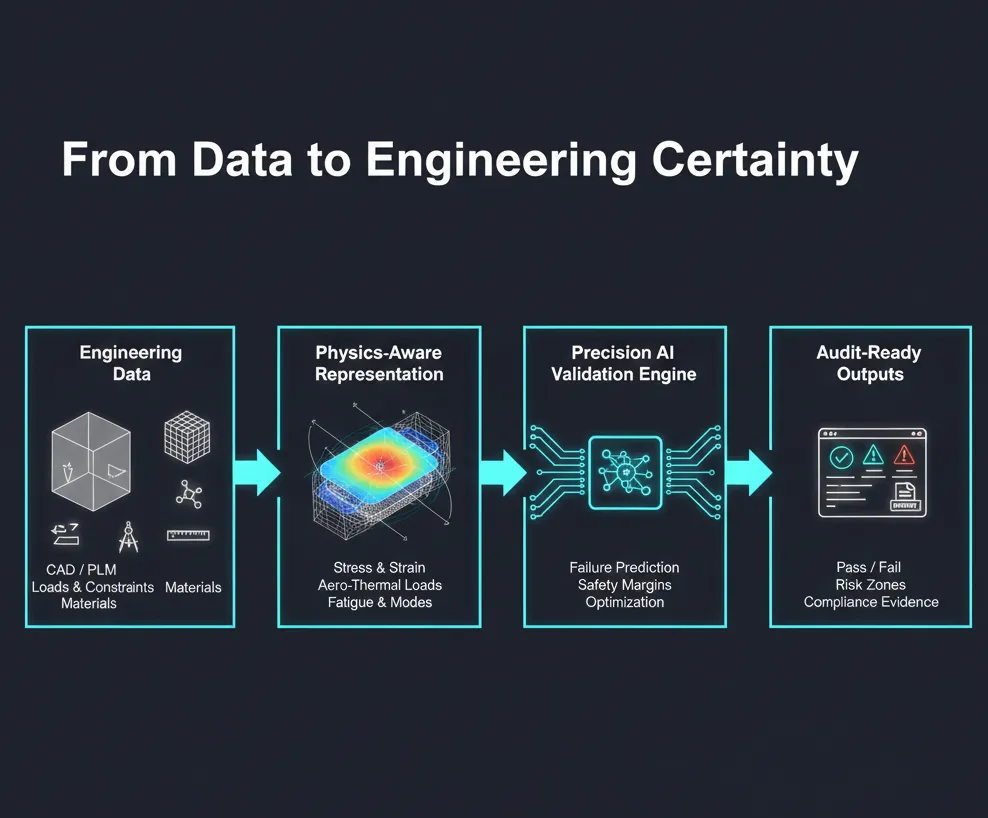
High-level workflow: CAD/PLM inputs → physics-aware intelligence core → stress / thermal / aero analytics → predictive failure forecasting → audit-ready validation outputs.
Precision Industrial Intelligence Validation Engine
The engine transforms the multi-layer representation into audit-ready validation, forecasting, and risk outputs—fast enough to run inside design loops, and strict enough for aerospace-grade constraints.
Architecture Components
- CAD/PLM Data Import Layer
- Mesh Graph Neural Network
- Physics-Residual Stress Model
- Aero-Thermal Load Predictor
- Fatigue & Crack Propagation Estimator
- Failure Mode Classifier
- Material Optimization Engine
- Automated Compliance Report Generator
Physics Constraints Used
Neodustria embeds aerospace-grade constraints to ensure credible, physics-consistent outputs—never black-box guesses.
- Navier–Stokes flow relations
- Von Mises stress limits
- Fatigue crack growth models (Paris Law)
- Thermo-elastic constitutive laws
- Composite layup orientation rules
- Joint stiffness & fastener shear limits
- Allowable deflection and stiffness windows (FAA/DoD standards)
Quantitative Results
| Metric | Traditional Approach | With Neodustria | Improvement |
|---|---|---|---|
| Design Validation Accuracy | 72% | 95% | +23% |
| Unscheduled Prototype Failures | 12 failures | 0 failures | 100% elimination |
| Material Waste Due to Failure | +48% | -4% | -52% |
| Stress Prediction Error | ±22% | ±5% | 4× more precise |
| Full CFD/FEM Simulation | 100h | 6 min | ×1000 faster |
| Physical Prototype Cost | $300k | $0 | 100% saved |
| Compliance & Reporting | 3–6 weeks | Instant | — |
| Design Iteration Cycles | 1–2 cycles | 12+ cycles | ×6 faster |
Visualization Suite
Multimodal visualization tools deliver auditability and engineering clarity for design leads and certification stakeholders—turning raw physics into actionable engineering decisions.
Von Mises & Principal Stress Maps
High-fidelity stress maps expose critical load concentrations across structural members and composite layers, enabling engineers to detect failure risk before fabrication.
- Immediate identification of stress hotspots
- Fastener and joint load concentration visibility
- Clear pass / fail safety margin interpretation
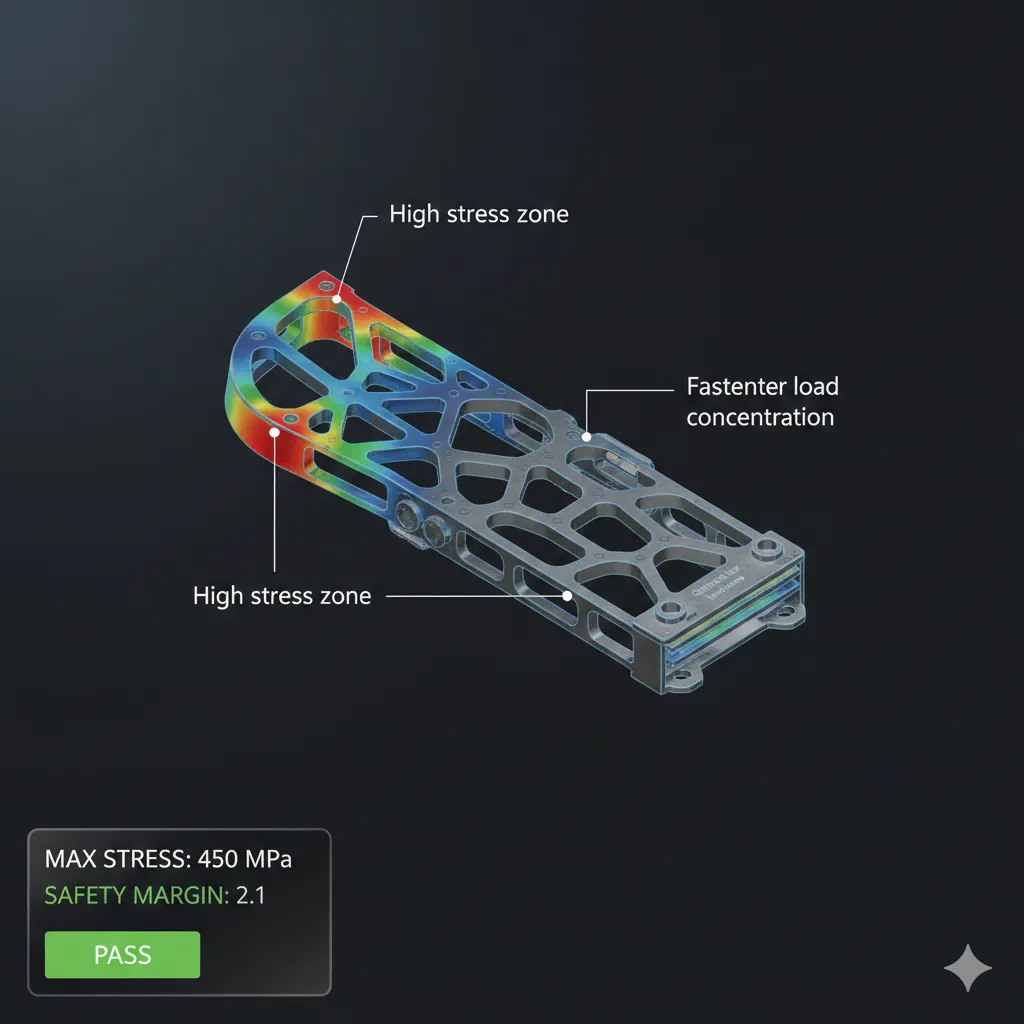
Von Mises and principal stress distribution highlighting critical structural risk zones.
Aero-Thermal Pressure Mapping
Combined aerodynamic pressure and thermal flux visualization reveals how airflow, heat, and turbulence interact with structural geometry under real operating conditions.
- Pressure coefficient (Cp) visualization
- Thermal hotspot detection
- Load envelope validation in real time
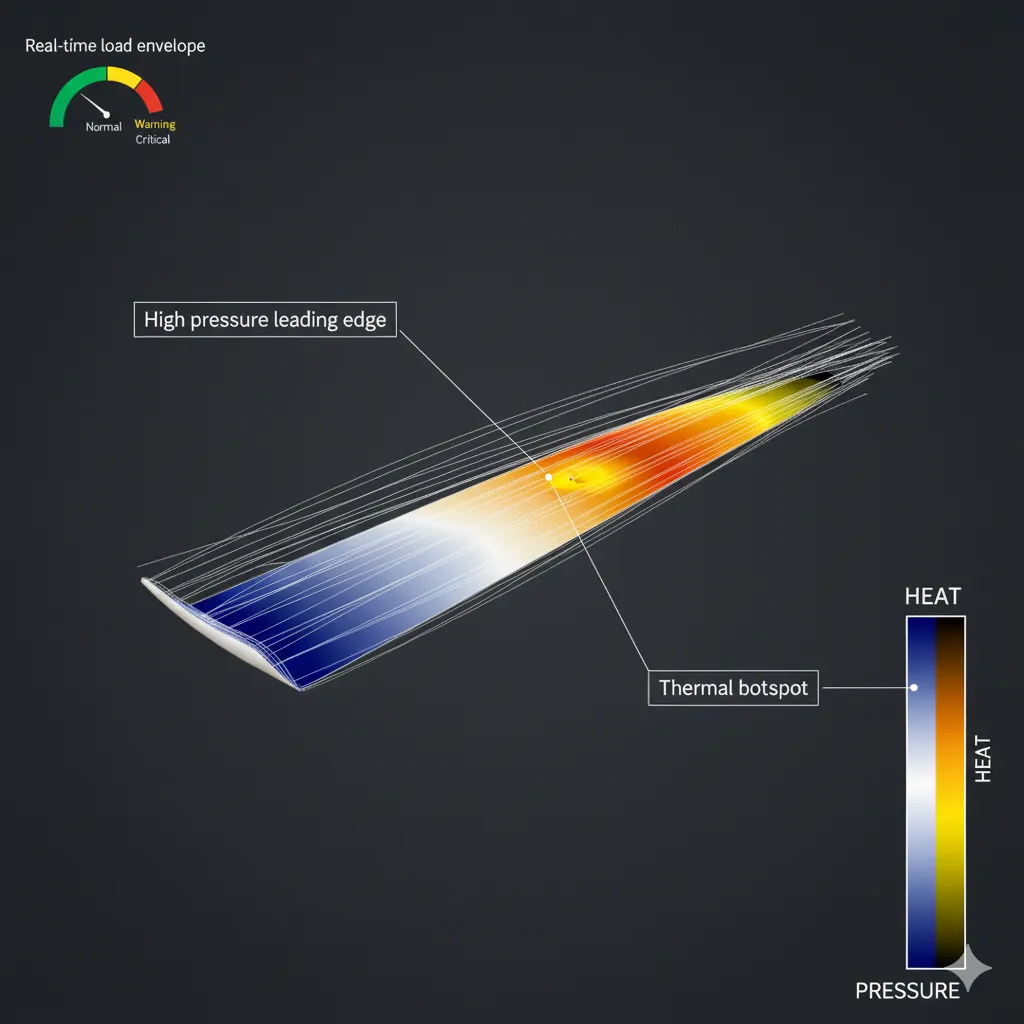
Aero-thermal mapping combining pressure, heat flux, and turbulence interaction.
Failure Mode Classification
Physics-aware classification pinpoints the exact physical origin of failure risk, replacing manual post-mortem analysis with instant engineering insight.
- Crack initiation detection
- Delamination and buckling risk
- Bond-line instability identification
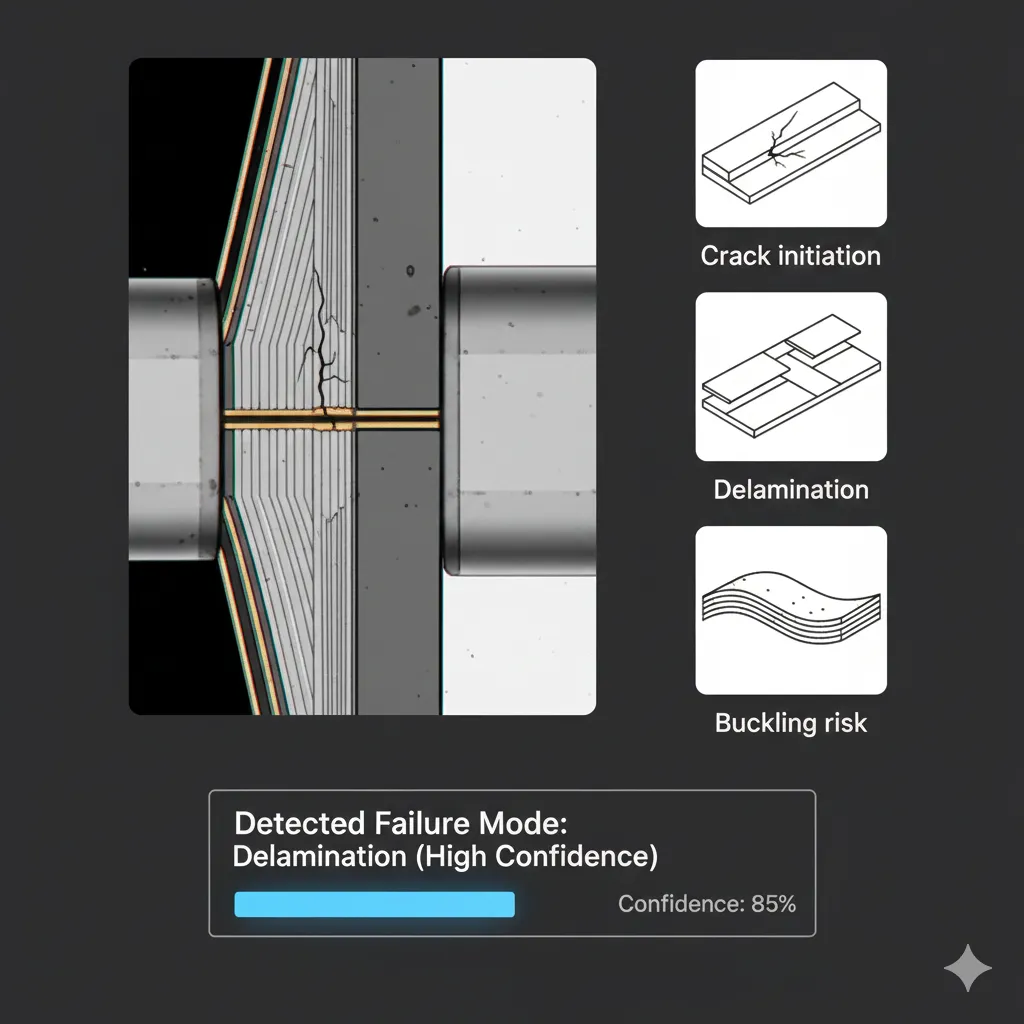
Automated classification of dominant failure mechanisms with confidence scoring.
Material Optimization View
The optimization view compares baseline and Neodustria-optimized designs, showing where material can be safely reduced without compromising structural integrity.
- Weight and cost reduction opportunities
- Ply orientation and thickness recommendations
- Safety margin preservation
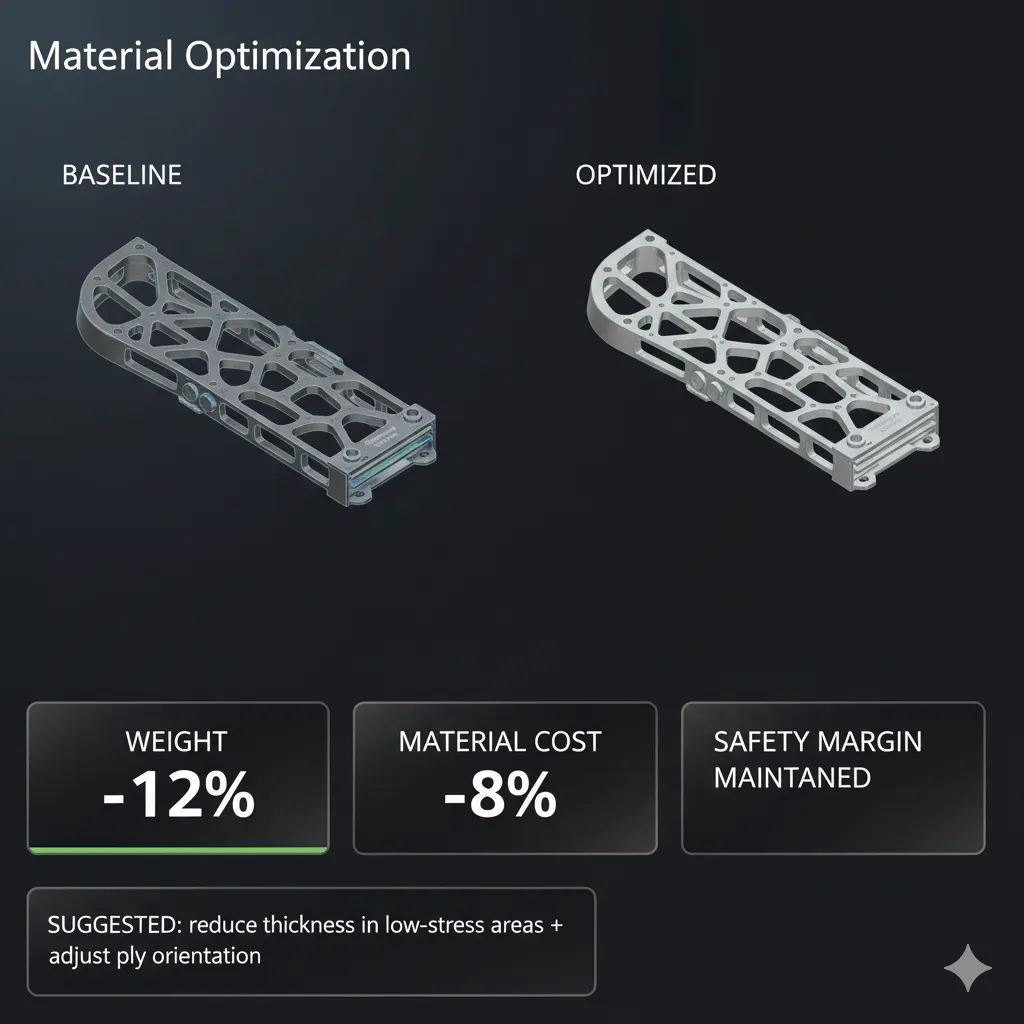
Before/after comparison highlighting physics-driven material and weight optimization.
Engineering Methodology
Neodustria’s methodology combines large-scale aerospace datasets, physics-informed learning, and multi-task optimization to deliver validation that is fast enough for design loops and strict enough for aerospace constraints.
Datasets Used
The engine is trained on a curated mix of geometry, simulation baselines, multi-physics load cases, material families, and failure archives—ensuring coverage across real operational regimes.
- 2,400 aerospace components (wing ribs, fuselage skins, composite layups)
- 18,000 multi-physics load cases (thermal, vibration, aerodynamic, compression, torsion)
- 70+ material types
- 120,000 FEM/CFD baseline records
- Historical prototype failure archives
Dataset coverage across geometry, multi-physics loads, materials, and failure archives.
Model Training Strategy
Training is designed to ensure accuracy, physical consistency, and robustness across materials and environments, while explicitly modeling fatigue and crack growth mechanisms.
- Multi-task modeling (stress, vibration, fatigue, failure modes)
- Physics-informed loss with aerospace constraints
- CAD geometry augmentation
- High-frequency load cycle simulation
- Domain randomization across materials and environmental conditions
- Crack propagation embedding
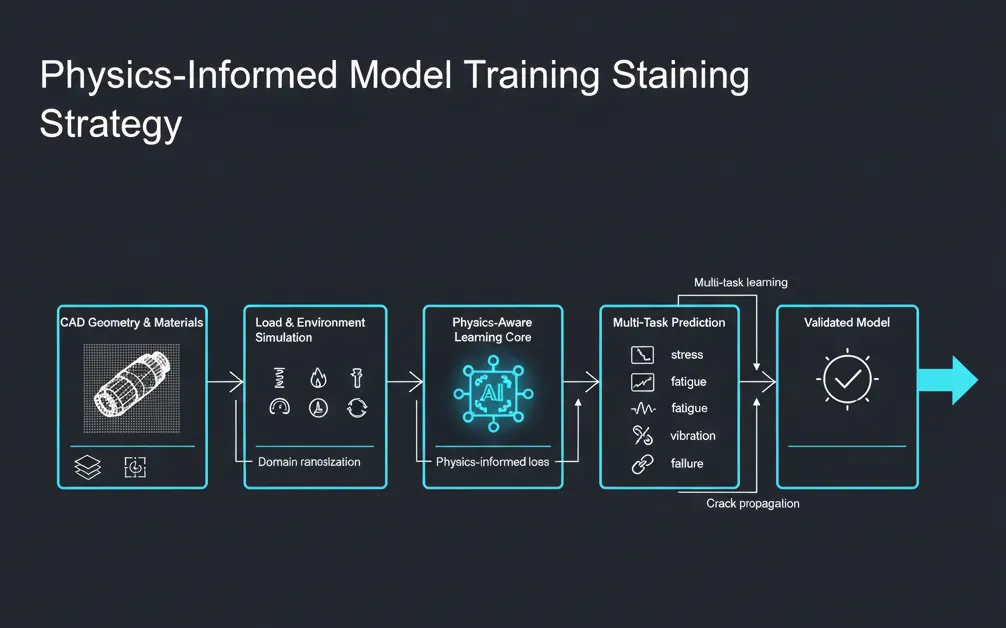
Physics-informed multi-task training for robust prediction across real operational regimes.
Business Impact
“Neodustria completely eliminated our prototyping failures. We validated components digitally before cutting a single billet of material.”
— Chief Aerospace Structures Engineer, Global OEM
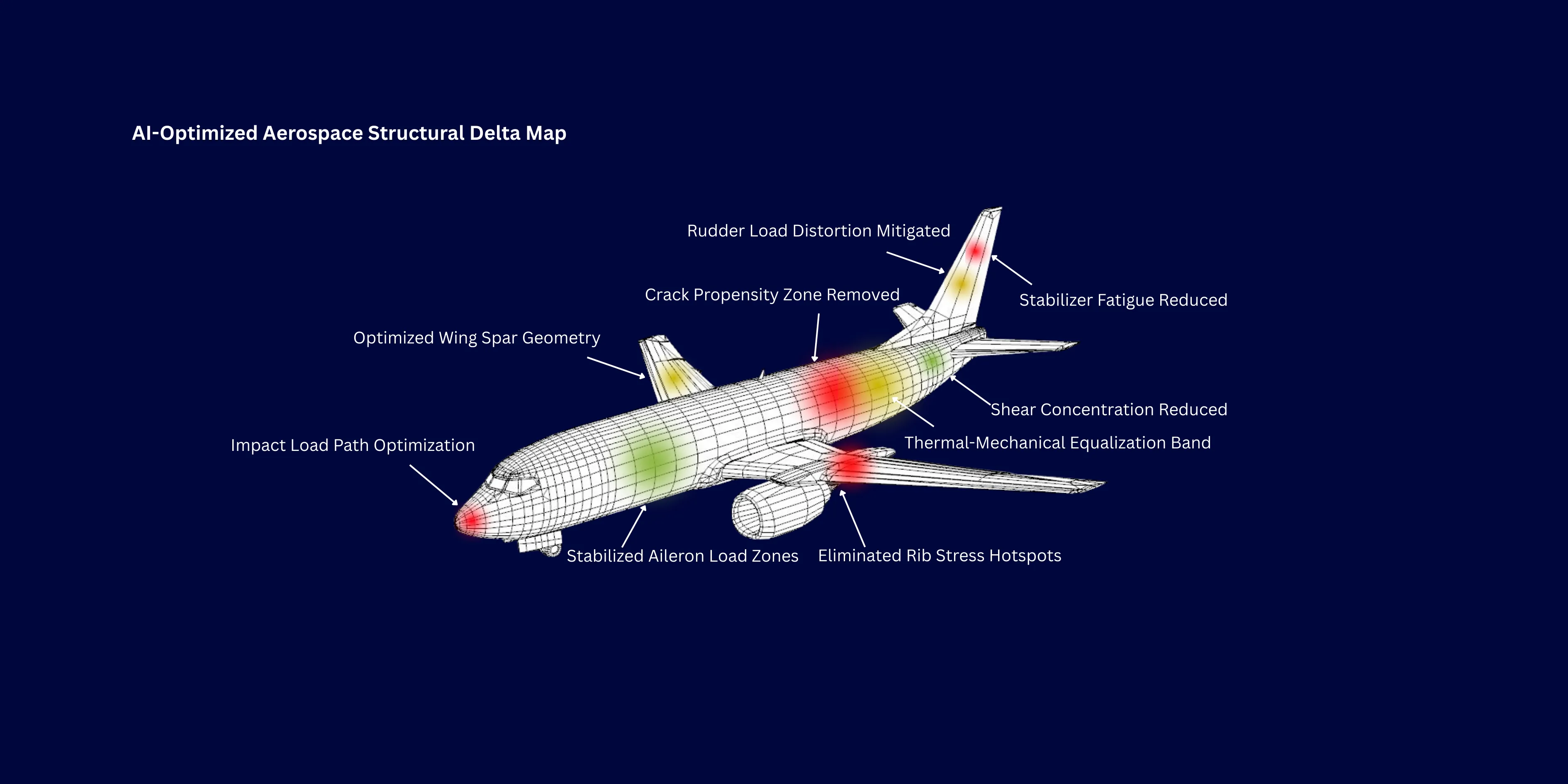
Integration Architecture
Neodustria integrates seamlessly into existing aerospace engineering workflows and toolchains, without disrupting certified processes or legacy environments.
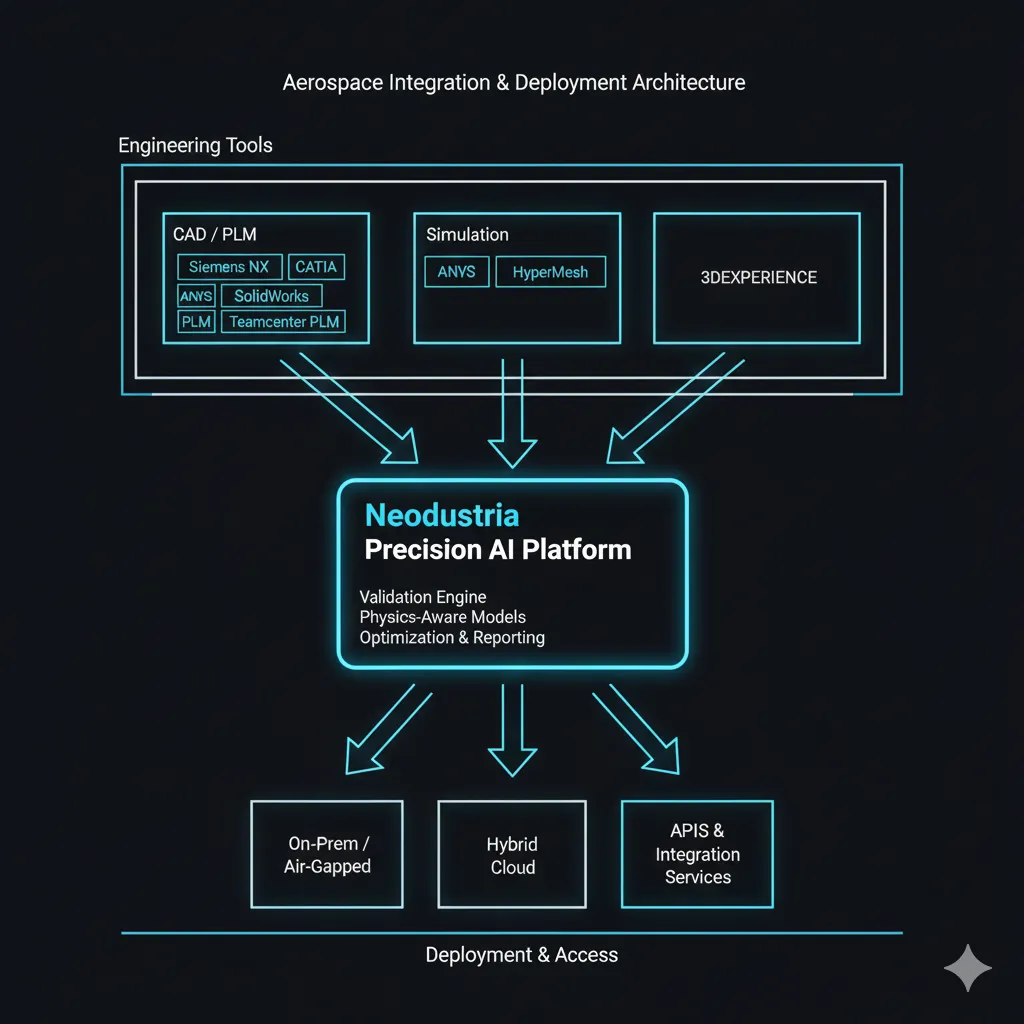
Integration and deployment architecture across engineering tools, Neodustria platform, and secure on-prem / hybrid cloud environments.
Systems Supported
- Siemens NX
- CATIA
- SolidWorks
- ANSYS
- HyperMesh
- Teamcenter PLM
- Dassault 3DEXPERIENCE
Deployment Modes
- On-prem / air-gapped deployments for secure programs
- Hybrid cloud for distributed engineering teams
- API-based integration with PLM, simulation, and reporting stacks
Conclusion
Neodustria shifts aerospace prototyping from an expensive, unpredictable failure-driven cycle into a real-time, physics-aware intelligence system—delivering stronger structural reliability, eliminating prototyping risk, reducing material waste, accelerating time-to-validation, and auto-generating compliance evidence.
This is the new paradigm for Aerospace Design Intelligence: certainty replaces assumption, and structural risk disappears before production begins.