Executive Summary
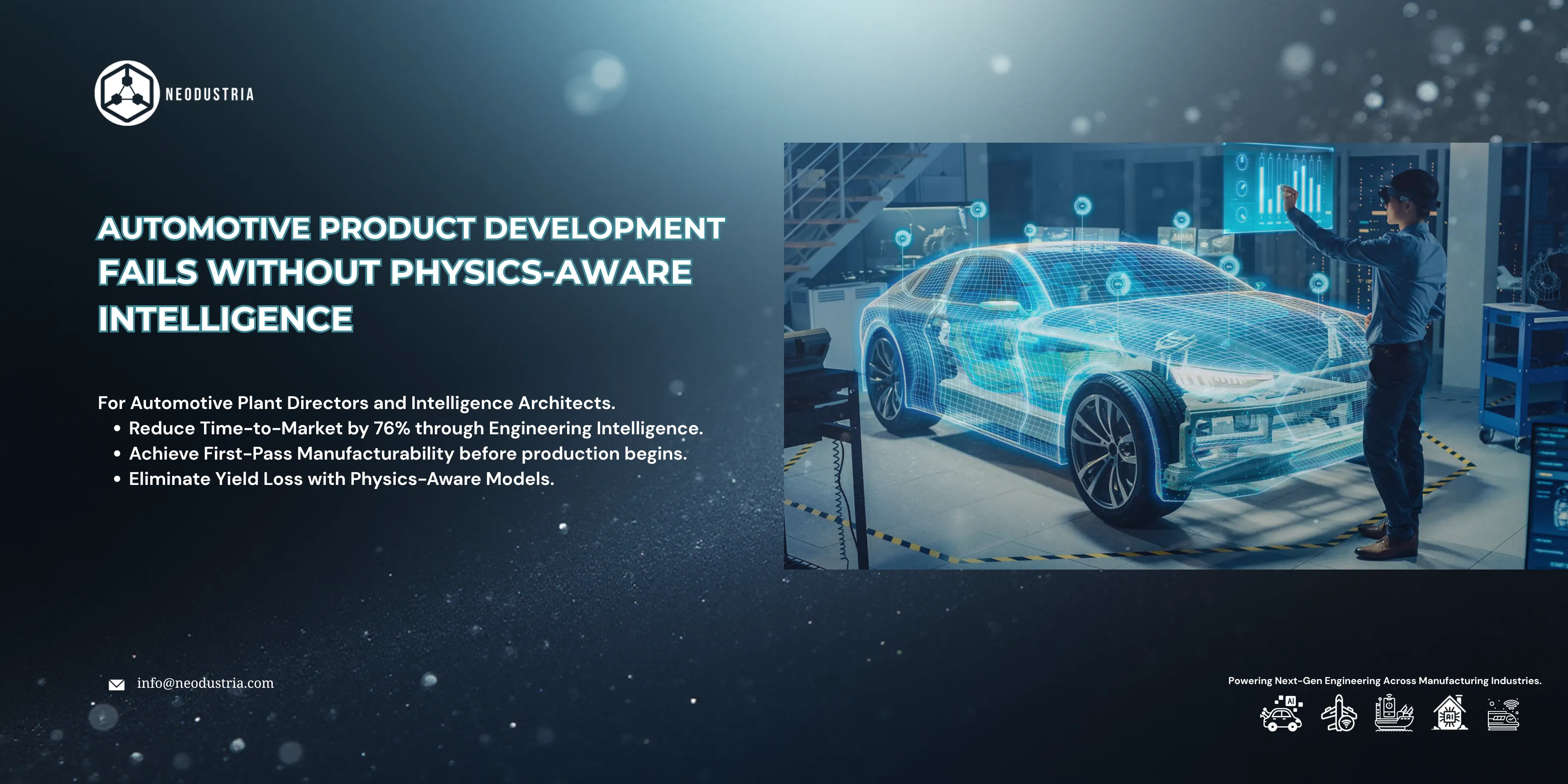
Automotive development is increasingly constrained by slow workflows and engineering uncertainty. By leveraging Neodustria’s precision industrial intelligence — geometry, physics, and materials fused into one engineering layer — teams compress launch timelines and replace rework with quantified certainty.
Neodustria orchestrates critical engineering data into a Unified Engineering Environment, eliminating friction between design and the shop floor—so manufacturability is validated before production begins.
Business Context & Strategic Impact
The Challenge
Automotive product development cells struggle with lengthy simulation cycles, engineering uncertainty, and bottlenecks that delay programs and increase yield loss risk.
Operational Pain
- Lengthy simulation cycles (CAD → prototype measured in weeks)
- Engineering uncertainty affecting yield and asset utilization
- Unified Engineering Environment bottlenecks (handoffs, tooling, approvals)
- High rework loops and late-stage redesign risk
- Lost market windows due to slow iteration
Market Demands
- Aggressive product launch schedules
- Reduced design iteration cycles
- Minimized scrap and downtime
- Engineering certainty in every decision
- Auditable workflows across design-to-shopfloor
Neodustria’s Solution: Precision Industrial Intelligence for Automotive Cells
Workflow optimization through physics-aware automation eliminates manual handoffs, reduces rework, and accelerates automotive product development cycles.
Neural Workflow Integration
- Automated digital twin creation from CAD/STEP
- Physics-aware models predicting stress, fatigue, and load
- Prescriptive recommendations for design optimization
- Real-time telemetry-driven performance feedback

KPI summary: High-fidelity simulations, reduced engineering uncertainty, and rapid iteration.
Key Engineering Benefits
- High-fidelity simulations up to 95% faster than traditional workflows
- Complete removal of manual meshing and pre-processing
- Reduced engineering uncertainty and rework by 80%
- Rapid iteration enabling 5× faster design validation
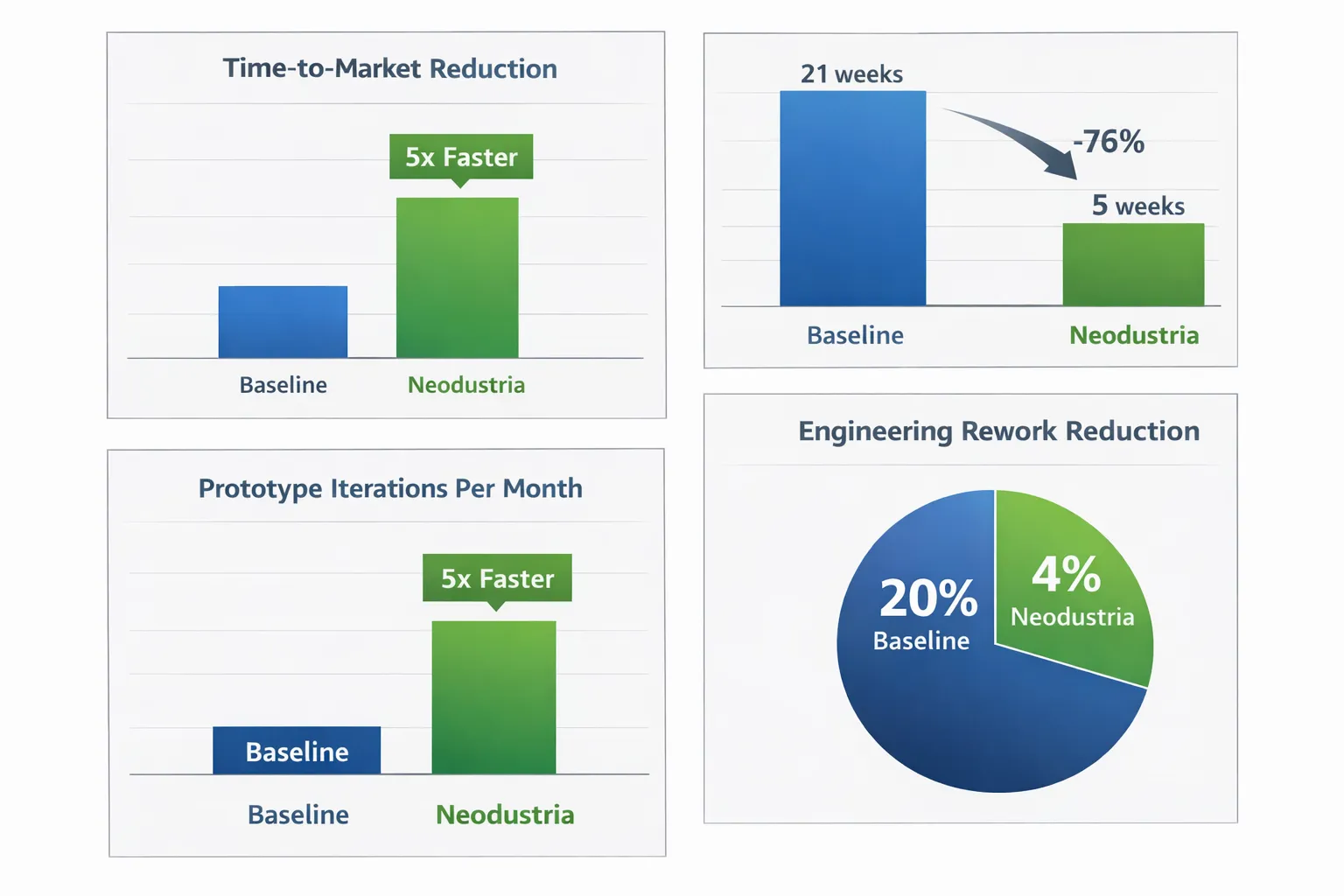
KPI summary: time-to-market reduction, prototype iteration acceleration, and rework reduction.
Quantitative Results
| Metric | Baseline | Neodustria Optimized | Improvement |
|---|---|---|---|
| Time-to-Market | 21 weeks | 5 weeks | -76% |
| Prototype Iteration | 1 per 4 weeks | 1 per week | ×5 |
| Engineering Rework | 20% | 4% | -80% |
| Digital Twin Validation Time | 48h | 2h | ×24 |
| Revenue Opportunity Capture | — | Enabled | +++ |
Engineering Methodology
Dataset & Simulation Scope
- 3,500+ CAD designs analyzed
- 10+ vehicle platforms
- 1–20M mesh resolution per simulation
- Physics-constrained training with digital twins
Training & Workflow Strategy
- Multi-task physics-aware intelligence models
- Digital twin augmentation and stress testing
- Integration with MES, PLC, and SCADA for real-world fidelity
- Continuous learning across neuron feedback loops
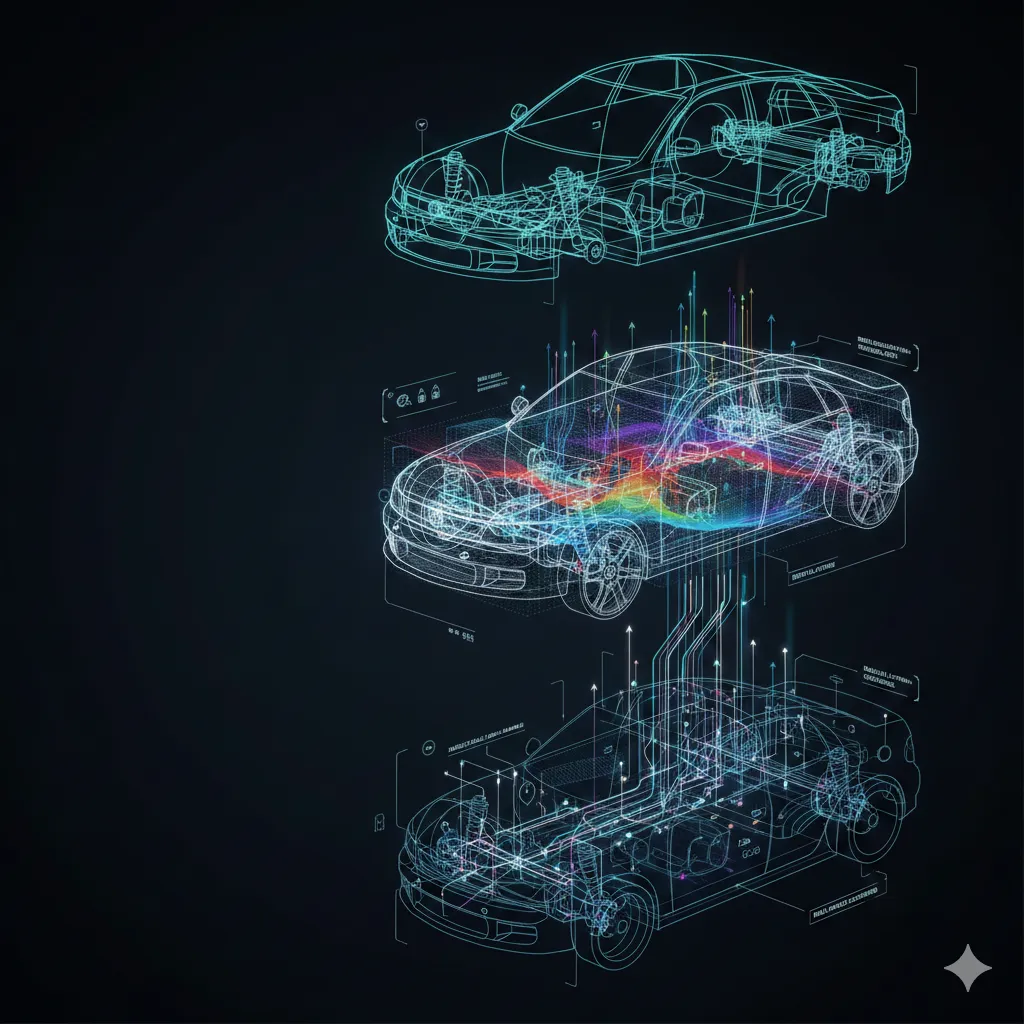
Physics-aware engineering pipeline combining CAD data, simulation, and intelligence-driven feedback loops.
Material Optimization Example
A representative optimization workflow illustrates how digital twin validation compresses from 48h to 2h (×24), while enabling weight and material cost reductions through physics-aware recommendations.
- Digital twin validation: 48h → 2h (×24)
- Weight reduction: up to ~35% (example scenario)
- Material cost reduction: up to ~18% (example scenario)
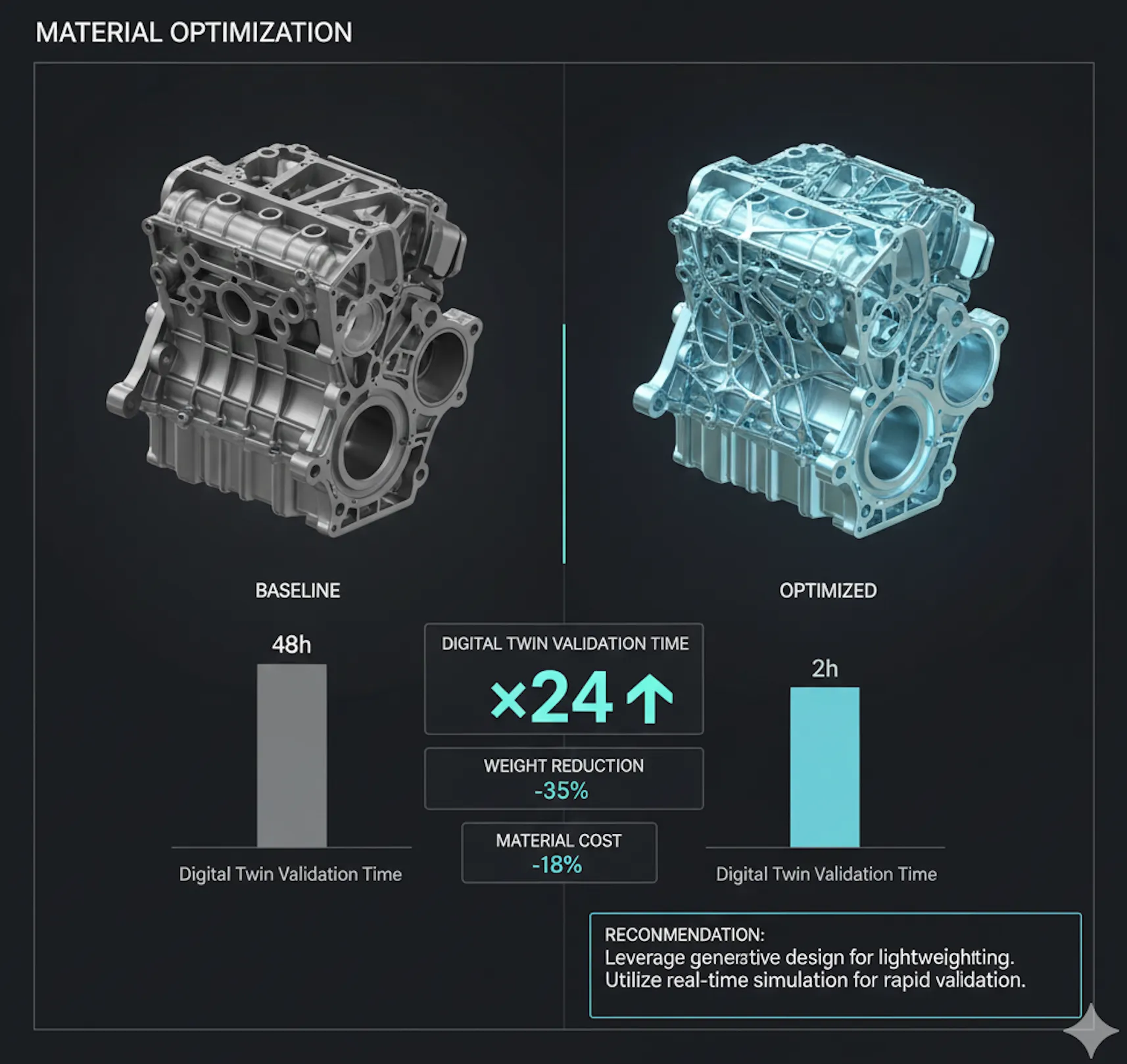
Material optimization visual: baseline vs optimized, with validation acceleration and cost/weight deltas.
Business Impact
“Neodustria transformed our product development cycles. What previously took 21 weeks now happens in 5 weeks, giving us a tangible competitive edge in market launches.”
— VP of Engineering, Global Automotive OEM
Potential Partnerships & Research Use Cases
- Academic collaborations on physics-aware industrial intelligence
- Real-world industrial dataset access
- Advanced digital twin curriculum
- Co-publication opportunities with leading automotive research labs
Deployment Model
- Direct integration with Autodesk, Siemens, Dassault, and PTC CAD APIs
- Sovereign Industrial Cloud or on-prem solutions
- Multi-cell engineering setup (design, simulation, manufacturing intelligence)
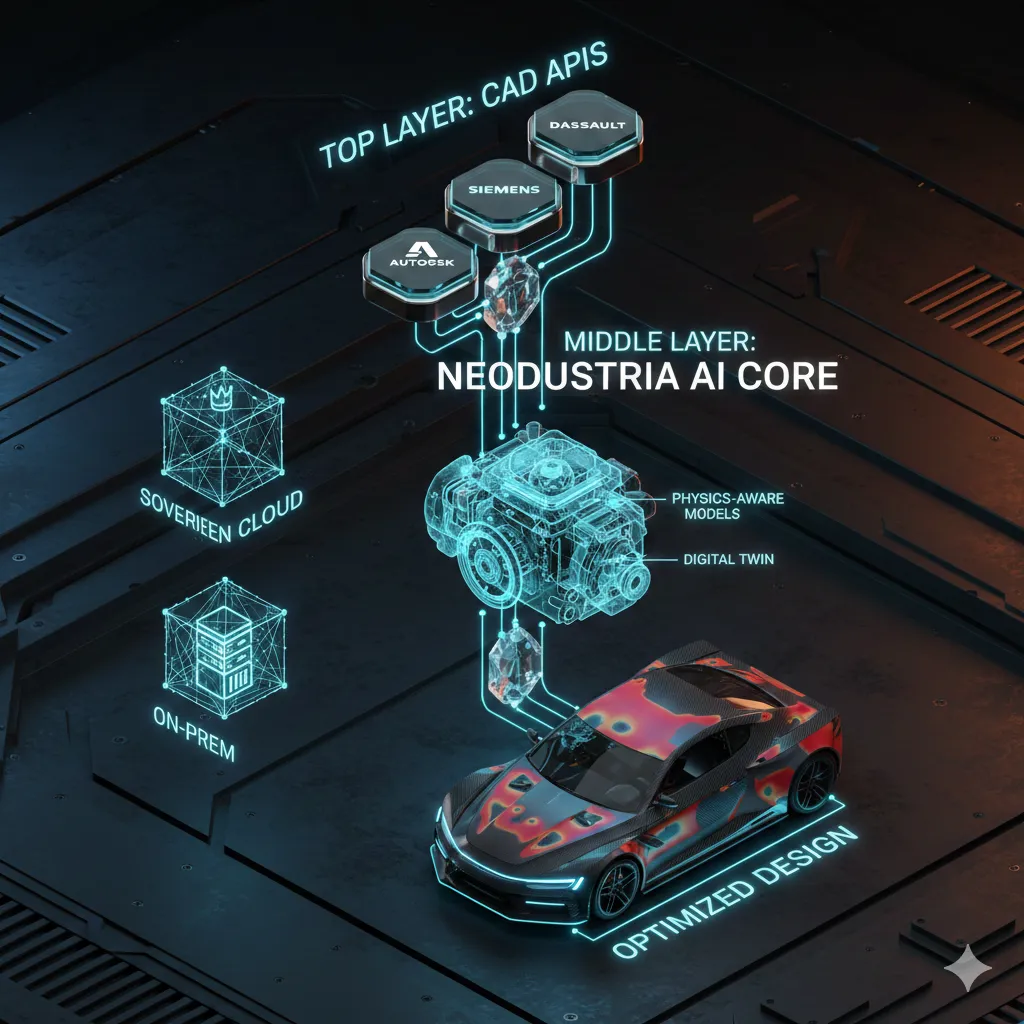
Integration path: CAD APIs → Neodustria Intelligence Core → physics-aware models + digital twin → optimized design.
Conclusion
Neodustria turns time-to-market from a limiting factor into a competitive advantage:
- From slow simulations → instant predictive insights
- From engineering uncertainty → quantified, physics-grounded intelligence
- From manual iteration → neuron-driven autonomous workflows
- From lost revenue → accelerated product launches
Neodustria redefines automotive innovation, where physics-aware industrial intelligence delivers certainty before production begins.