
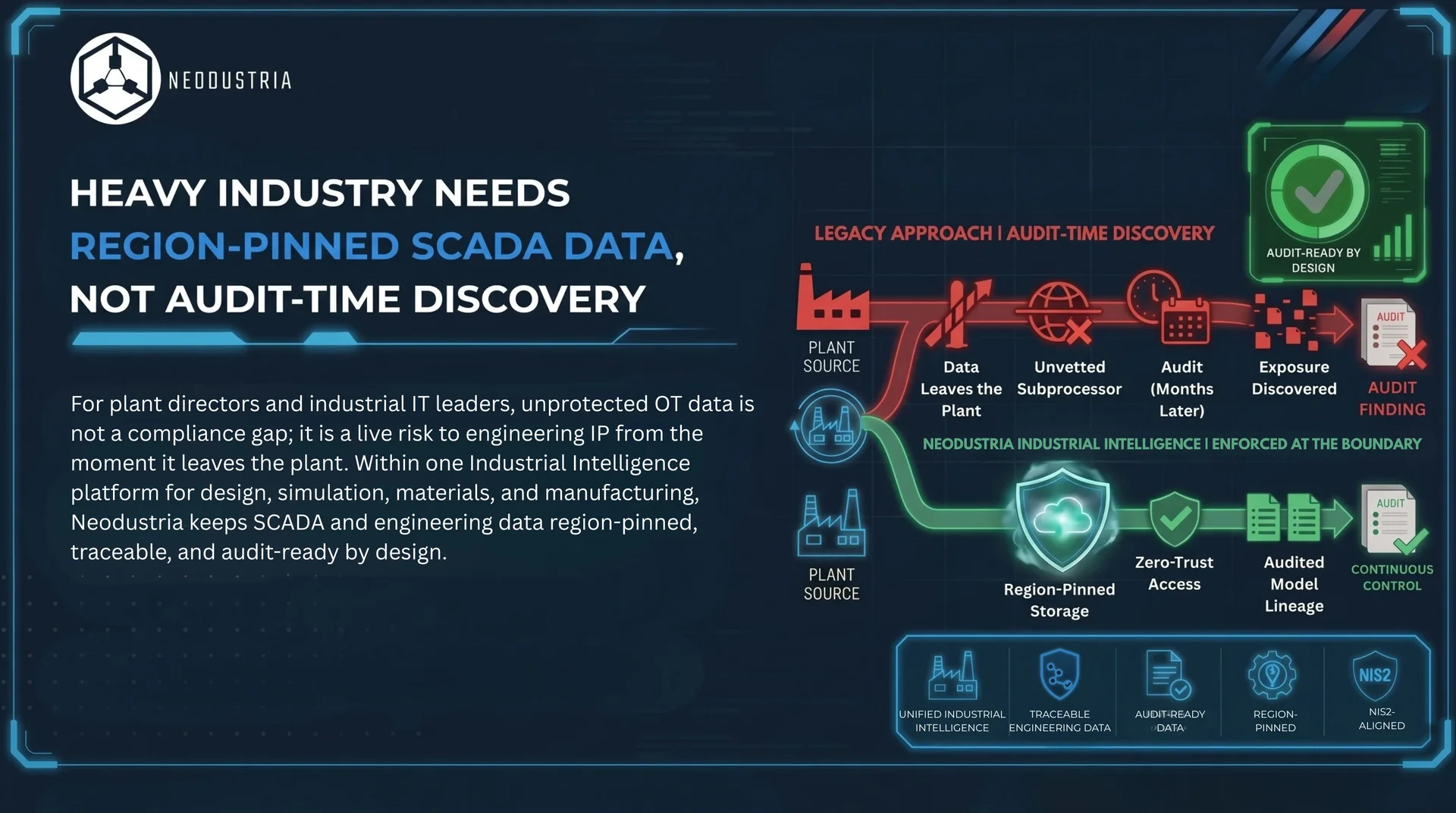
A compliance incident doesn't start with a breach. It starts the moment OT data leaves the plant and nobody confirms where it landed.
CISOs and Industrial IT Directors feel this pressure daily: protect engineering IP, pass every audit, and do it while more plant systems push OT data toward more third-party clouds every quarter. Every new integration, every new vendor, every new data pipeline is one more place where region-pinned control can quietly slip. The cost rarely arrives as a single event. It surfaces as a subprocessor nobody vetted, telemetry that crossed a border nobody approved, a data residency question nobody can answer fast enough, and an audit finding that traces back - not to a breach - but to a control gap nobody closed in time.
Why OT Data Exposure Latency Is a Compliance Risk
OT data exposure latency is the time between four events: SCADA or engineering data leaving plant-floor systems, that exposure being discovered (usually at a scheduled audit or after an incident), a remediation plan being approved across legal, security, and IT, and the exposure being validated as closed. On most industrial sites, that clock starts running the moment data leaves the plant, but nobody is watching it until the next audit cycle.
The data at stake is specific: historian records, PLC tag values, alarm and event logs, process setpoints, and the CAD and simulation models that encode years of engineering IP.
In many heavy industry organizations:
- OT and SCADA data is routed to public cloud infrastructure faster than anyone can confirm where it physically resides
- Third-party subprocessor relationships change without triggering a review of what data they can now touch
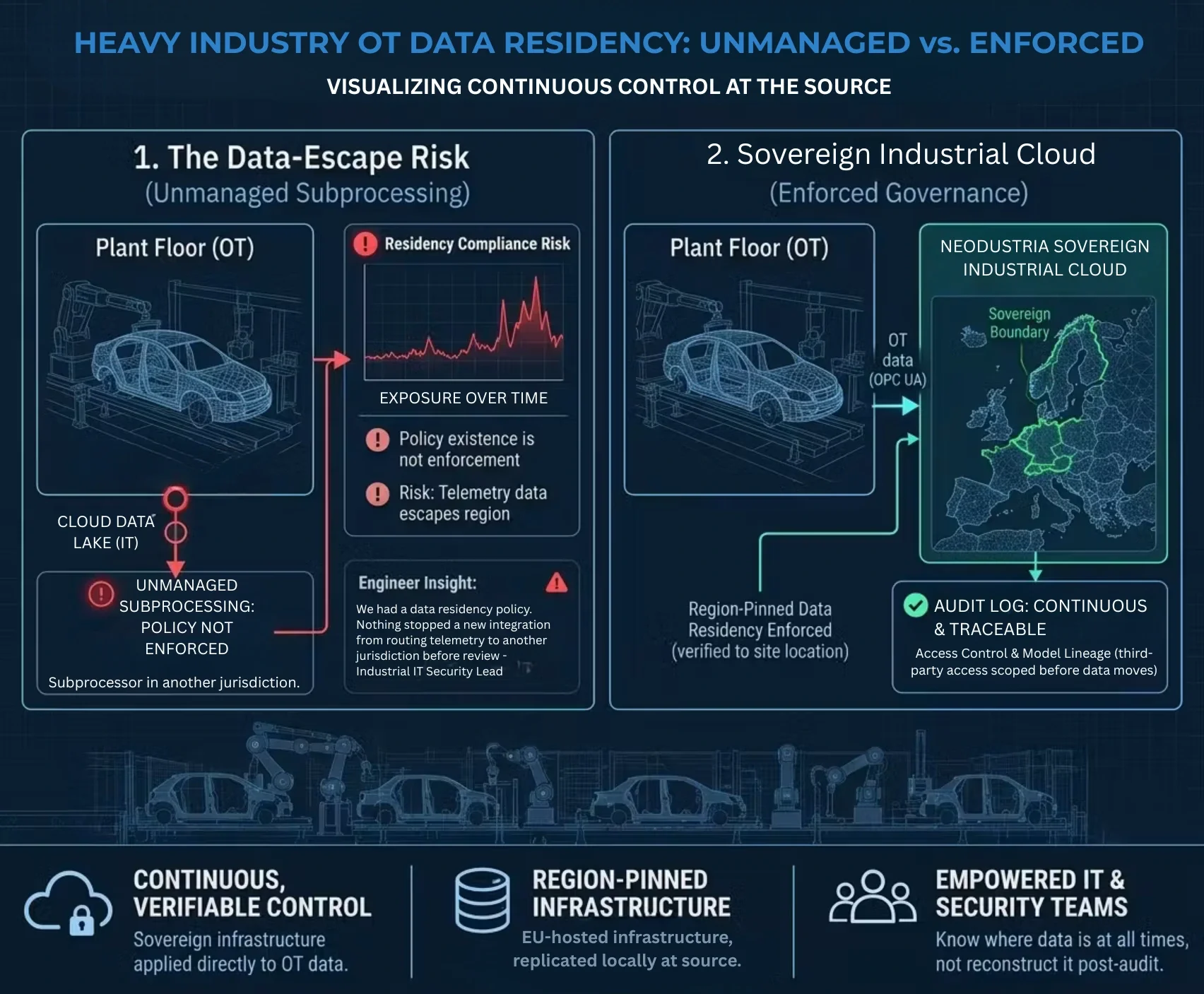
- Public cloud platforms were built for general-purpose workloads and broad data portability, not for region-pinned OT governance and zero-trust industrial access control, so region and access requirements get documented in policy but not enforced in the infrastructure itself
- Exposure is discovered at the next scheduled audit instead of prevented at the point data tries to leave the plant
The regulatory stakes are rising as well. The EU's NIS2 Directive extends cybersecurity risk-management and incident-reporting duties to more sectors, including critical product manufacturing, and makes top management accountable for non-compliance. For heavy industry, OT data governance is no longer only an IT policy question. It is a board-level obligation.
This fragmented governance chain compounds into regulatory fines, lost engineering IP, and audit findings that could have been prevented at the boundary. The risk isn't that heavy industry uses cloud infrastructure, it's how long the gap is between data leaving the plant and someone confirming it's still under control.
What Region-Pinned OT Governance Actually Requires
Neodustria's Sovereign Industrial Cloud enforces data residency, access control, and audit logging directly at the point OT data would otherwise leave the plant, the same data engineering and IT already generate, kept under continuous, verifiable control instead of policy that's confirmed only when someone asks.
By orchestrating data residency rules, access identity, and model lineage tracking in one environment, Neodustria empowers industrial IT teams to know where their data is at all times, not reconstruct it after an audit request. This is the foundation of Neodustria's EU Data Sovereignty standard, built into every engagement model.
Sovereignty here is not a marketing label. Peer-reviewed research in the International Journal of Information Security analyzes NIS2 as one of the EU's key instruments for putting digital sovereignty into practice (Kianpour, 2025). That is why region-pinned control has to be enforced in the infrastructure, not only written into policy.
Engineer Insight:
"We had a data residency policy. What we didn't have was anything that stopped a new integration from routing telemetry through a subprocessor in another jurisdiction before anyone reviewed it. The policy was right. Nothing was enforcing it."
Industrial IT Security Lead
The Solution: Zero-Trust Governance at the Boundary
Neodustria's Sovereign Industrial Cloud pairs region-pinned storage with a zero-trust access boundary mapped to the actual data flows of the plant. Its job is not to produce a compliance checklist that gets reviewed quarterly, it's to enforce residency and access rules at the infrastructure layer, so an unauthorized egress attempt is blocked the moment it happens, not flagged the next time someone audits the logs. Instead of waiting for a scheduled review, the governance layer confirms residency, access, and lineage continuously.
This follows the direction of joint U.S. government guidance on adapting zero trust principles to operational technology, which notes that as OT systems become interconnected and remotely monitored, perimeter-based defenses and implicit trust models are no longer adequate.
- Data residency location, encryption-at-rest status, and access logs are enforced continuously, not sampled at audit time
- Third-party subprocessor access is scoped and reviewed before it can touch OT data, not discovered after
- Every model trained on plant data carries an audited lineage record, linking outputs back to their data sources
- A Sovereign Industrial Cloud keeps telemetry, models, and access history inside a single compliant, EU-hosted environment
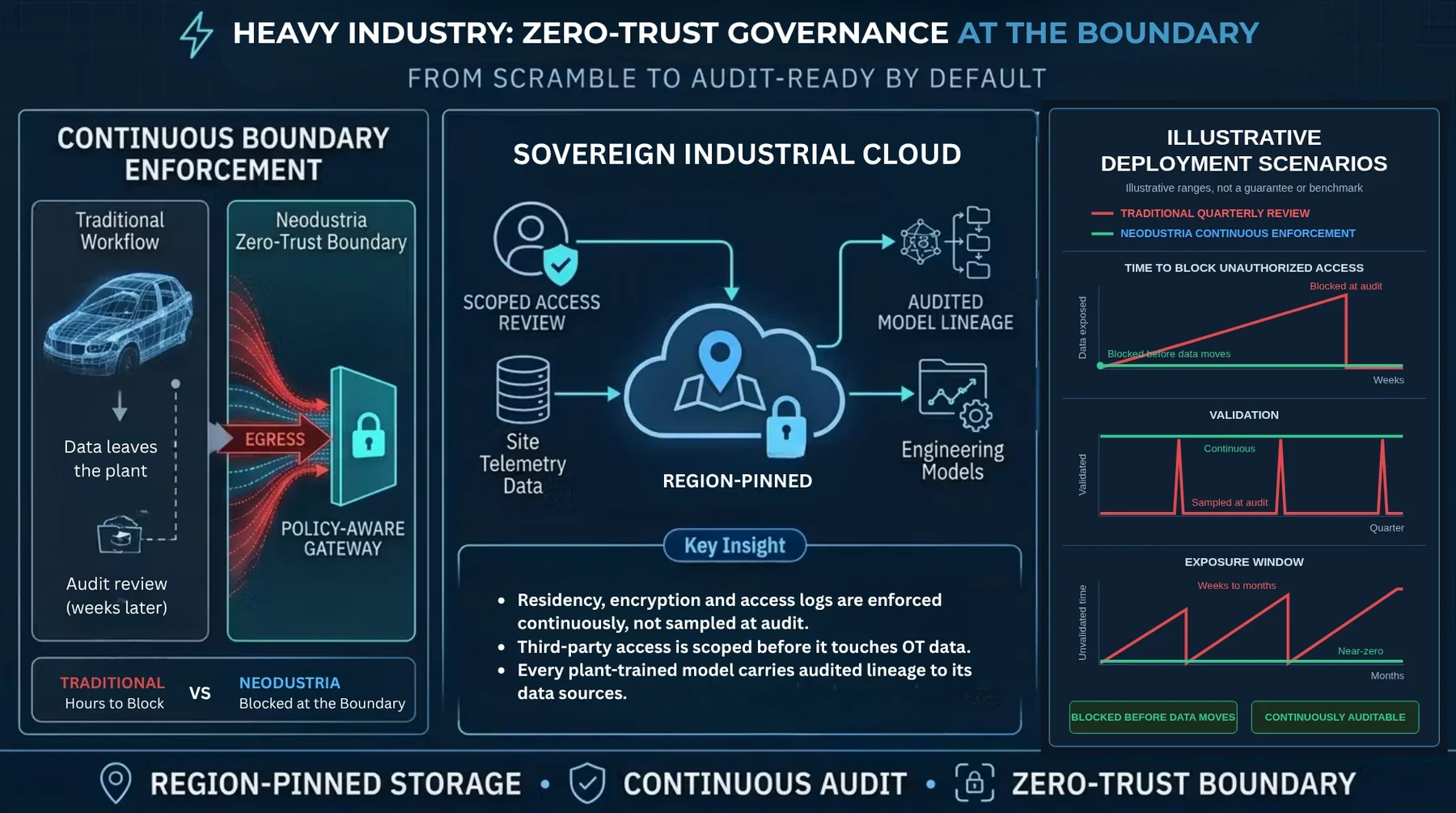
Scenarios are illustrative, not an absolute claim or a named pilot result; actual results will vary by organization and regulatory jurisdiction.
This connectivity allows industrial IT teams to close the exposure-to-closure gap, protect engineering IP, and stay audit-ready by default instead of by scramble.
Mini Case Study: Closing a Subprocessor Gap Before the Audit
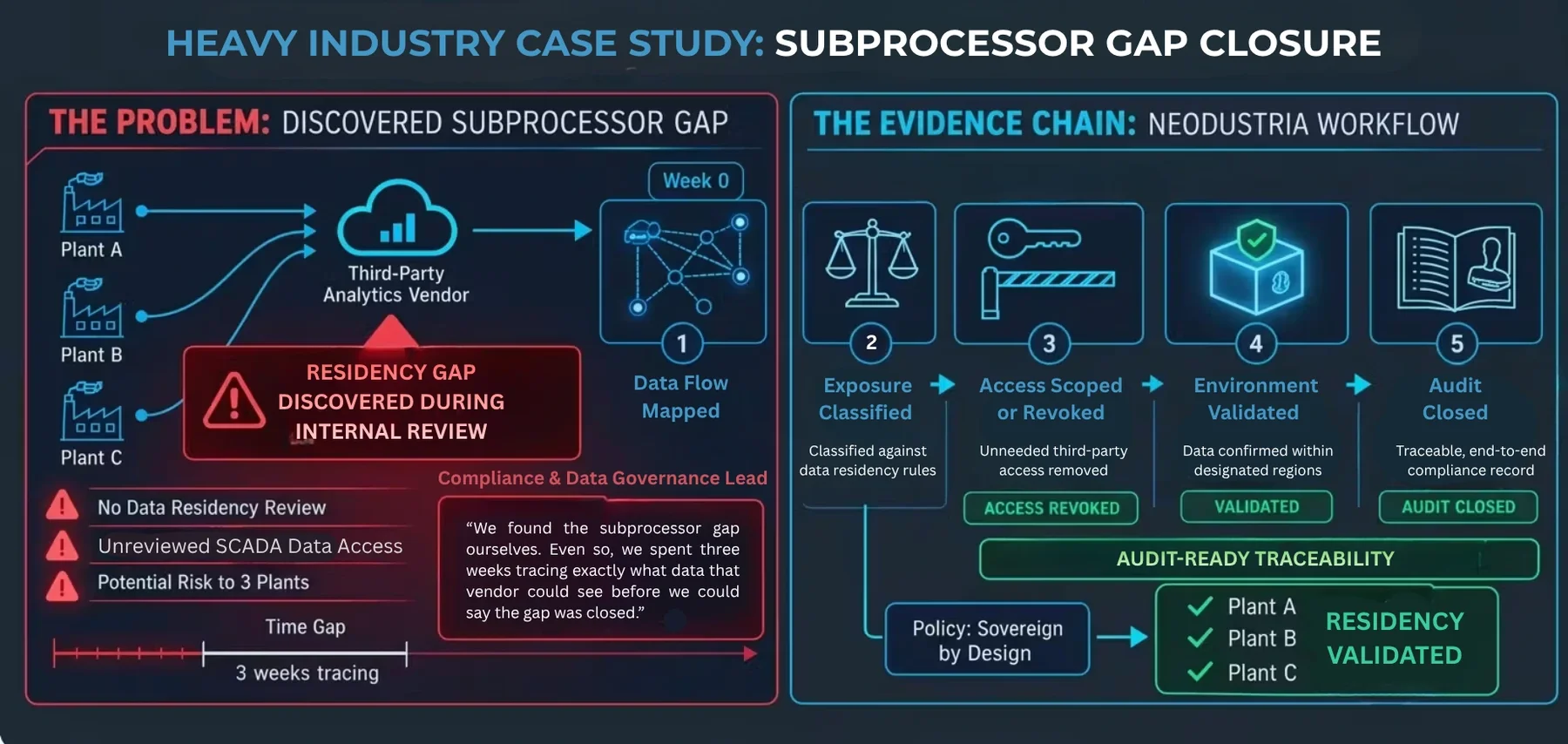
An industrial IT team discovered, during a routine internal review, not an external audit, that a recently added analytics vendor had subprocessor access to SCADA telemetry from three plants, none of which had been reviewed against data residency requirements.
The evidence chain Neodustria closes looks like this: data flow mapped → exposure classified against residency rules → access scoped or revoked → sovereign environment validated → audit closed with a full record. Every link stays traceable; only the time between links changes.
Engineer Insight:
"We found the subprocessor gap ourselves, which is the good version of this story. The bad version is an auditor finding it first. Either way, we spent three weeks tracing exactly what data that vendor could see before we could say the gap was closed."
Compliance & Data Governance Lead
Zero-Trust Governance: Human + Industrial Intelligence Working the Same Loop
Continuous OT data governance is not automation at any cost. It is Industrial Intelligence working alongside security and compliance teams, inside the same review loop, with every access decision traceable back to a region and identity rule. This is the same principle Neodustria builds into its own platform: zero-trust OT access, region-pinned data, and decisions that stay explainable and auditable by design.
Key Features of Neodustria's Sovereign Industrial Cloud
Region-Pinned Data Storage
OT and engineering data stays inside a defined jurisdiction by default, synchronized with the Unified Engineering Data Fabric so residency is enforced, not just documented.
Zero-Trust Access Boundary
Every access request, human or system, is checked against identity and region rules before data moves, blocking unauthorized egress continuously.
Audited Model Lineage
Every model trained on plant data carries a traceable record back to its source, so audit questions have an answer before an auditor asks.
Sovereign Industrial Cloud
Telemetry, models, and access history stay inside a single, compliant, EU-hosted environment, fully traceable for audit and engineering review, sovereign by design, independent from global hyperscalers.
Govern data at the speed it actually moves. This is no longer "audit, then discover." This is designing with the boundary built in.
Final Verdict: Compress the Loop Between Exposure, Detection, and Closure
That's the real shift Neodustria makes for heavy industry OT data: compressing the loop between exposure, detection, and closure, not managing each stage better in isolation. A zero-trust OT architecture with region-pinned data sits directly at the boundary where data would otherwise leave the plant unmonitored. The same four steps still happen: data movement, exposure review, remediation, closure; they just happen continuously inside one governance loop instead of being reconstructed at the next audit.