The Era of Passive Design is Over.
Industry 5.0 is not about faster machines — it is about systems that reason, decide, and execute engineering workflows with production certainty built in from the first iteration.
From Passive Systems to Agentic Manufacturing Intelligence
For leaders and practitioners across aerospace, automotive, naval, and precision manufacturing, the competitive landscape has fundamentally shifted. Where previous generations of engineering software provided dashboards and recommendations, the next generation of industrial intelligence acts: it reasons across engineering constraints, validates feasibility in real time, and executes complex workflows with minimal friction.
Industrial teams currently face compounding pressure — shorter product development cycles, tighter quality requirements, rising material costs — without proportionally more engineering capacity. The gap that has always existed between conceptual design and production-ready reality has not narrowed on its own. Agentic industrial intelligence is the bridge.
The Hidden Bottleneck: Design Without Manufacturability
Across heavy industry, organizations continue to optimize design phases while deferring manufacturability validation to the end of the development cycle. The pattern is predictable: a design passes internal review, moves toward production, and then encounters problems — tolerances that cannot be held, geometries that require tooling not available, material choices that inflate lead time.
Even when teams adopt parametric or generative CAD tools, the validation step remains external to the design environment. Engineers submit files, wait for DFM feedback, receive redlines, and start another redesign loop. This fragmented cycle consumes weeks and tens of thousands of dollars per iteration — not because the engineers lack skill, but because the system is structurally broken.
"Manufacturing has become smarter than the designs it is asked to build."
Identifying manufacturability gaps early — during design, not after — is the single most reliable way to reduce rework and compress the time between concept and production.
Digital Design Co-Pilot: Closing the Design-to-Reality Loop
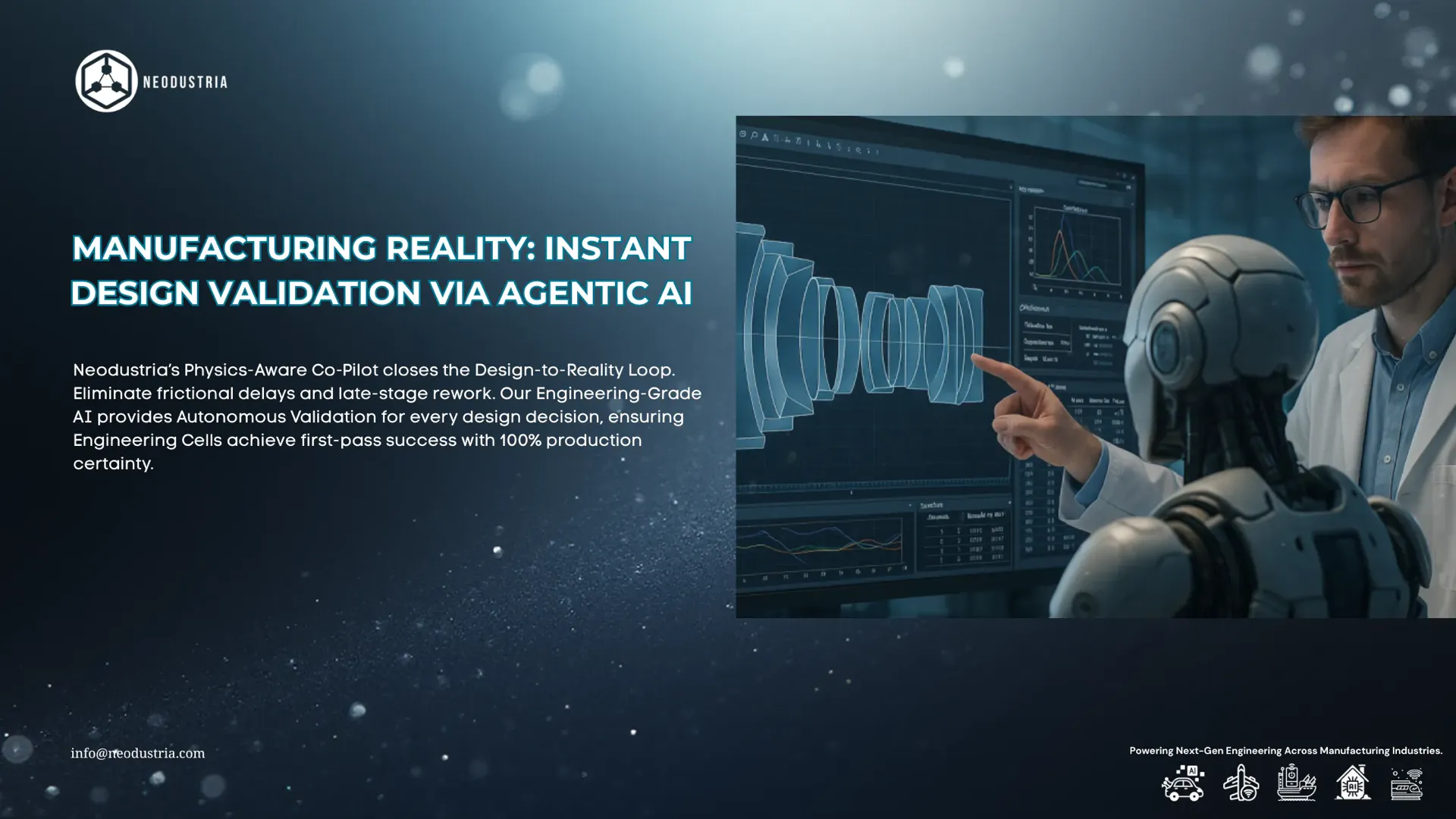
Neodustria's Digital Design Co-Pilot embeds manufacturability intelligence directly into the design phase, eliminating the gap between intent and production reality. Rather than treating validation as a downstream gate, the platform makes it a continuous, real-time signal that engineers can act on immediately.
- Intelligent 3D modeling that anticipates production constraints as geometry evolves
- Real-time simulation that surfaces feasibility issues before they become redesign triggers
- Physics-aware manufacturability checks that explain why a design will cause problems — not just whether it will
- Instant feedback on cost, lead time, and supplier availability as design parameters change
The result is a workflow where engineers converge on production-ready outcomes faster — not by working harder, but by working with a system that eliminates the uncertainty that drives iteration.
Physics-Aware Validation in Real Time
At the core of Neodustria's approach are physics-aware neural networks trained on industrial manufacturing data, combined with process simulations and benchmarks aligned with real-world production capabilities. This combination allows the platform to reason about manufacturability the way an experienced process engineer would — but at a speed and scale that no human team can match.
When a design change is made, the system evaluates it against manufacturing constraints in milliseconds: casting tolerances, machining reachability, surface finish requirements, weld geometry, composite layup feasibility. Engineers see not just a pass/fail result, but an explanation they can act on — which constraint is violated, by how much, and what design alternatives would resolve it.
Ranges represent illustrative workflow impact from source material and reported case outcomes. Results vary by application and context.
Case Example: Robotics Actuator Development
A mid-sized robotics manufacturer was developing a high-precision actuator for an industrial automation system. The engineering team faced a familiar problem: complex geometry requirements, tight tolerance stacks, and a production cell with specific machining constraints. Each redesign cycle consumed roughly three weeks and cost approximately $30,000 in engineering time and prototype tooling. After seven iterations, the project was significantly over schedule and over budget.
Legacy DFM processes contributed to the problem rather than solving it — feedback arrived too late, was too generic, and created friction rather than resolution between the design and manufacturing teams.
Before
- Multiple redesign cycles consuming 3 weeks each
- ~$30,000 cost per iteration
- Manufacturability errors identified late — after design freeze
- Fragmented feedback between engineering and production
After
- Real-time manufacturability feedback during design iteration
- Prototype costs reduced by ~65%
- Design cycles reduced by ~62%
- First-pass manufacturing improved by approximately 38 percentage points
The shift was not in the engineers' capability — it was in when and how they received actionable information. By embedding manufacturability intelligence into the design phase itself, the team eliminated the wait-and-fix cycle that had been the default operating mode.
Human + Industrial Intelligence Collaboration for Industry 5.0
Industry 5.0 is often discussed in terms of what automation will replace. The more useful frame is what it enables: a human-machine collaboration that amplifies engineering judgment rather than replacing it. Where Industry 4.0 emphasized data connectivity, Industry 5.0 integrates industrial intelligence with human expertise to drive manufacturing outcomes that neither could achieve alone.
Neodustria's system is designed explicitly around this principle. The platform does not make design decisions — it provides engineers with validated, physics-grounded information at the moment they can act on it. Engineers retain full authorship of the design. The platform handles the cognitive load of cross-checking every iteration against the full space of manufacturing constraints.
- Simulate and validate complex industrial scenarios using generative design intelligence and process-aware models
- Compare design trade-offs in real time using a unified decision-support interface
- Adapt faster to manufacturing constraints, improving resilience and reducing uncertainty
- 60–70% reduction in supplier dependency for feasibility checks
- More than 25% savings in prototype and iteration costs (reported range)
Core Capabilities
Cloud Application Services
A secure, cloud-hosted environment that removes local setup constraints and enables seamless collaboration across global engineering cells — with live design data and manufacturability feedback accessible from anywhere.
Intelligence-Powered Material & Process Suggestions
Dynamic recommendations for materials and manufacturing processes, with predicted impact on cost, lead time, and manufacturability — enabling confident, data-backed decisions early in the development cycle.
Instant Cost & Lead Time Estimation
Real-time visibility into how every design change affects production timelines and cost — eliminating late-stage surprises and increasing first-pass success rates from the first iteration.
Precision Engineering, Redefined by Agentic Industrial Intelligence.
Every design iteration is smarter, faster, and production-ready from the start — because manufacturability is no longer a gate at the end of the process. It is woven into every step.